


 Bosnia and Herzegovina : Safety by City
Bosnia and Herzegovina - safety as a country
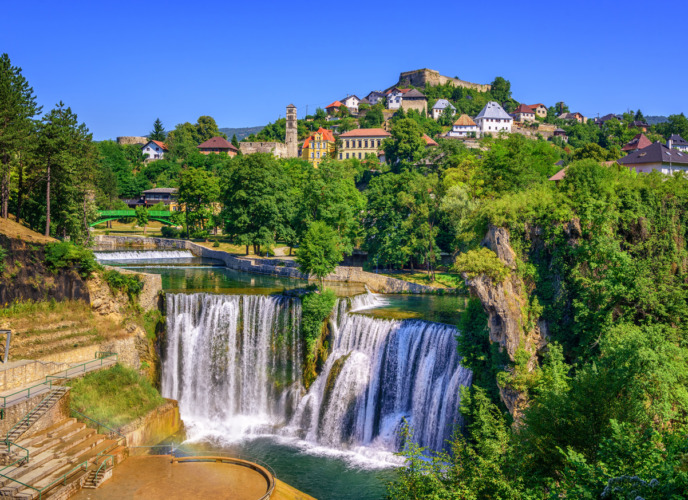
Jajce is one of Bosnia and Herzegovina’s most unusual small towns, sitting where the Pliva River plunges more than 20 meters into the Vrbas beneath a medieval hilltop fortress.
Located in central Bosnia, roughly between Sarajevo and Banja Luka, Jajce combines waterfalls, lakes, Ottoman-era streets, medieval fortifications, catacombs, wooden watermills, and important Yugoslav history within a surprisingly compact area.
The town was once the seat of Bosnian kings, and its historic core still climbs steeply toward the fortress above the valley.
Most travelers come for the spectacular Pliva Waterfall and nearby Pliva Lakes, but Jajce deserves more than a quick photo stop.
It is generally a safe destination, with low violent crime and few tourist scams.
Roads, water, winter weather, and unexploded ordnance in remote countryside deserve more attention than street crime.
Warnings & Dangers in Jajce

OVERALL RISK: LOW
Jajce has a low overall risk for ordinary tourists. The historic center is compact, violent crime against visitors is uncommon, and most attractions can be explored comfortably during daylight. The main concerns are road safety, petty theft, slippery paths, fast-moving water, and the remaining landmine risk in remote or abandoned areas outside established tourist routes.

TRANSPORT & TAXIS RISK: MEDIUM
Transport risk is medium mainly because of Bosnia’s mountain roads. Routes around Jajce can be winding, narrow, poorly illuminated, and affected by snow, rockfall, or heavy rain. Local taxis are generally safe. Use seatbelts, avoid unnecessary night driving, and slow down considerably on mountain roads, particularly in winter or bad weather.

PICKPOCKETS RISK: LOW
Pickpocketing is uncommon in Jajce, although crowded summer weekends, festivals, bus stops, markets, and popular viewpoints can create opportunities. Keep wallets and phones secured and avoid leaving bags unattended at cafes or beside the lakes. The risk is considerably lower than in major European capitals and heavily visited Adriatic destinations.

NATURAL DISASTERS RISK: MEDIUM
Flooding, landslides, heavy rain, thunderstorms, snow, ice, and rockfall create a medium environmental risk. Jajce sits among rivers and steep terrain, so weather can affect both roads and walking routes. The Pliva and Vrbas can become more powerful after heavy rain. Avoid flooded roads, unstable slopes, and closed waterfront areas.

MUGGING RISK: LOW
Muggings are rare in central Jajce. The old town, waterfall area, restaurants, and main tourist streets generally feel comfortable during the day and evening. Risk increases slightly on quiet roads, isolated lakeside sections, and dark paths late at night. Carry limited cash and use a taxi if your accommodation is far from the center.

TERRORISM RISK: LOW
The terrorism risk in Jajce is low. Bosnia and Herzegovina has experienced security concerns in the past, but ordinary tourists in Jajce are unlikely to encounter terrorism. Visitors should maintain normal awareness around large public events and religious gatherings and avoid demonstrations or any location with an unusual police or security presence.

SCAMS RISK: LOW
Scams are uncommon in Jajce. Possible issues include taxi overcharging, unclear parking fees, unofficial guides, or accommodation charges that were not explained beforehand. Confirm prices before accepting services and use established tour operators for regional excursions. Aggressive tourist scams and organized street fraud are not major features of the town.

WOMEN TRAVELERS RISK: LOW
Jajce is generally safe for women, including those traveling alone. Central streets, hotels, cafes, attractions, and buses are usually comfortable during normal hours. Standard precautions still apply after dark. Avoid isolated walking routes alone, use trusted transportation late at night, and tell someone your route before longer countryside hikes.

TAP WATER RISK: LOW
Tap water in Jajce is generally safe to drink. Bosnia and Herzegovina has good freshwater resources, and many residents drink directly from municipal supplies. Travelers staying in older rural properties may want to ask about the local plumbing or storage system. Bottled water is readily available for anyone who prefers it.
Safest Places to Visit in Jajce
Jajce Old Town and Fortress
The historic center is the easiest and safest place to explore.
Stone streets climb toward Jajce Fortress through old gates, churches, mosques, houses, and medieval remains.
During daylight, the area receives a steady flow of visitors and residents.
The bigger safety issue is footing.
Streets and fortress paths can be steep, uneven, and slippery after rain or snow, so wear shoes with good grip.
Pliva Waterfall
Pliva Waterfall is Jajce’s signature attraction and sits directly beneath the old town.
Official viewing areas provide the safest way to experience it.
The waterfall is powerful, particularly after heavy rain or snowmelt.
Do not climb barriers, stand on wet rocks, or attempt to swim near the falls.
Spray can make viewing platforms surprisingly slippery.
Pliva Lakes
The Great and Small Pliva Lakes sit roughly 5 kilometers west of central Jajce and offer kayaking, picnicking, walking, and beautiful scenery.
Established recreational areas are generally safe for families.
Ask locally about swimming conditions and designated access points.
Not every section of shoreline is suitable for entering the water.
Mlinčići Watermills
The traditional wooden watermills between the Pliva Lakes are one of the area’s most photogenic attractions.
Boardwalks and designated paths make the site easy to explore.
Do not climb onto fragile mill structures or enter fast-moving channels.
Children should remain closely supervised around the water.
Places to Avoid in Jajce
Unmarked Rural Land
The most important warning outside Jajce concerns landmines and unexploded ordnance left from the 1992 to 1995 war.
Populated areas, major roads, and established tourist attractions have largely been cleared, but risks remain in some remote countryside.
Never wander through abandoned fields, neglected orchards, forests, ruined structures, or unmarked tracks to explore.
Stay on paved roads and established hiking routes unless accompanied by someone with current local knowledge.
Abandoned Buildings
Do not treat ruined and abandoned structures as urban exploration opportunities.
Apart from possible unexploded ordnance in some areas, old buildings may have unstable floors, damaged roofs, exposed metal, broken glass, or collapsing walls.
Photograph them from established roads rather than entering.
Waterfall and River Edges Outside Viewing Areas
Avoid unofficial paths leading toward the base or edge of Pliva Waterfall.
The same applies to fast sections of the Pliva and Vrbas rivers.
Wet limestone is extremely slippery, and currents can be much stronger than they appear from shore.
Barriers and closures should always be respected.
Mountain Roads During Severe Weather
Roads connecting Jajce with Travnik, Banja Luka, Sarajevo, and smaller villages can become hazardous during heavy snow, ice, flooding, or landslides.
If road authorities or residents recommend delaying a journey, take the advice.
Mountain road conditions can deteriorate much faster than conditions inside town.
Safety Tips for Traveling to Jajce
- Stay on established paths in the countryside. Bosnia and Herzegovina still contains landmines and unexploded weapons from the 1990s conflict. Central Jajce and major attractions are not places where tourists normally encounter them, but remote forests, abandoned land, old battle areas, and neglected buildings are different. Do not leave marked trails just to reach a viewpoint or ruin.
- Do not climb around Pliva Waterfall. The waterfall looks close enough to tempt adventurous visitors toward unofficial viewpoints. Resist that temptation. Spray makes rocks extremely slippery, currents are powerful, and a fall into the water could become serious immediately. Use designated observation areas and keep children close to barriers.
- Drive slowly on mountain roads. Roads around Jajce can have sharp bends, steep drops, cyclists, motorcycles, trucks, and limited shoulders. Avoid speeding and expect slower journeys than navigation apps suggest. Night driving is best minimized because lighting is limited and hazards are much harder to spot.
- Check weather before leaving town. Heavy rain can produce landslides, rockfall, flooded roads, and higher river levels. Winter adds snow and black ice. Ask your accommodation about conditions before driving toward Travnik, Banja Luka, or remote villages, particularly after storms.
- Wear proper shoes. Jajce is a town of hills, stone steps, fortress paths, wet viewing platforms, and cobblestones. Sneakers or walking shoes with good grip make sightseeing much safer. Sandals with smooth soles become surprisingly useless once rain reaches the old-town streets.
- Keep valuables secured during busy periods. Jajce is not a pickpocketing hotspot, but summer crowds create opportunities. Keep wallets in front pockets or closed bags and do not leave your phone sitting on an outdoor cafe table. Store passports and unnecessary cash securely at your accommodation.
- Treat Pliva Lakes as natural water, not a swimming pool. Ask where swimming is currently recommended and pay attention to depth, temperature, boat activity, and currents. Wear life jackets when kayaking or boating and supervise children continuously. Do not enter fast channels around the watermills.
- Avoid hiking alone into unfamiliar terrain. Marked routes close to established attractions are generally fine, but remote countryside requires more thought. Use an experienced guide for unusual routes and never improvise shortcuts across fields or forests. Download maps beforehand because phone coverage may weaken outside populated areas.
- Carry some cash. Cards are increasingly accepted, but cash remains useful for small restaurants, parking, attraction tickets, cafes, taxis, and rural businesses. Carry convertible marks in smaller denominations and keep backup cash separate from your main wallet.
- Use travel insurance for outdoor activities. A normal visit to Jajce is low-risk, but kayaking, cycling, hiking, swimming, and road trips increase the chance of injury. Choose insurance covering medical treatment, road accidents, lost luggage, outdoor activities, and weather-related disruption.
So... How Safe Is Jajce Really?
Jajce is a safe destination for most travelers and one of the easier smaller towns to visit in Bosnia and Herzegovina.
Serious violent crime against tourists is uncommon, scams are limited, and the compact historic center feels relaxed during both daytime sightseeing and normal evening hours.
The biggest risks have little to do with criminals.
Jajce is built around steep terrain and powerful water.
Pliva Waterfall, the Pliva Lakes, mountain roads, wet stone, and winter ice demand more attention than pickpockets.
Travelers who stay behind barriers and drive carefully remove much of the practical risk.
The legacy of the Bosnian War is another important consideration.
Landmines and unexploded ordnance remain in parts of Bosnia and Herzegovina, primarily away from populated areas and established routes.
Tourists should never wander through abandoned fields, forests, ruined buildings, or unmarked countryside.
Road safety also matters.
Bosnia’s mountain scenery is spectacular, but winding roads and unpredictable weather can make journeys slower and more challenging than expected.
I assess that Jajce has a low crime risk and a medium outdoor and transportation risk.
Families, couples, solo travelers, and older visitors can all enjoy the town safely.
Stay on established routes, respect the waterfall, check road conditions, and avoid unnecessary nighttime driving.
How Does Jajce Compare?
| City | Safety Index |
|---|---|
| Jajce |
90 |
| Banja Luka |
60 |
| Bihac |
85 |
| Tuzla |
84 |
| Mostar |
72 |
| Travnik |
88 |
| Sarajevo |
65 |
 Stroudsburg Stroudsburg | 82 |
| Chapel Hill | 81 |
| Coralville | 87 |
 Dubrovnik Dubrovnik | 90 |
| Perryville | 88 |
| Cañon City | 87 |
Useful Information

Visas
Bosnia and Herzegovina allows citizens of many countries, including most European Union countries, the United States, Canada, the United Kingdom, and Australia, to visit without a visa for up to 90 days within a 180-day period. Other nationalities may require a short-stay visa. Passport requirements should always be checked before departure.

Currency
Jajce uses the Bosnia and Herzegovina convertible mark, abbreviated BAM or KM. The currency is fixed at approximately 1.96 marks to €1. Cards work at many hotels, restaurants, and supermarkets, but smaller businesses often prefer cash. ATMs are available in town, and euros should be exchanged rather than assumed to be accepted everywhere.

Weather
Jajce has warm summers, cold winters, and significant seasonal rain. Summer daytime temperatures commonly reach the mid-to-upper 20s Celsius, while winter can bring freezing temperatures and snow. Spring produces impressive waterfall flow. Pack layers, comfortable shoes, rain protection, and warm winter clothing if visiting from November through March.

Airports
Banja Luka International Airport is the closest airport, roughly 95 kilometers away by road and usually around two hours by car. Sarajevo International Airport is approximately 135 to 145 kilometers away and offers a wider selection of flights. Split and Zagreb are additional options for travelers combining Bosnia with Croatia.

Travel Insurance
Travel insurance is recommended for Jajce, particularly if your trip includes driving, hiking, cycling, kayaking, or swimming. Choose coverage for medical treatment, road accidents, lost belongings, weather disruption, and emergency transportation. Travelers planning extensive hiking should confirm that outdoor activities are specifically included in their policy.
Jajce Weather Averages (Temperatures)
Average High/Low Temperature
| Temperature / Month | Jan | Feb | Mar | Apr | May | Jun | Jul | Aug | Sep | Oct | Nov | Dec |
|---|---|---|---|---|---|---|---|---|---|---|---|---|
| High °C |
3 | 5 | 10 | 15 | 20 | 24 | 26 | 27 | 22 | 16 | 9 | 4 |
| Low °C |
-5 | -3 | 0 | 4 | 9 | 12 | 14 | 14 | 10 | 6 | 2 | -3 |
| High °F |
37 | 41 | 50 | 59 | 68 | 75 | 79 | 81 | 72 | 61 | 48 | 39 |
| Low °F |
23 | 27 | 32 | 39 | 48 | 54 | 57 | 57 | 50 | 43 | 36 | 27 |
Bosnia and Herzegovina - Safety by City
| City | Safety Index |
|---|---|
| Banja Luka | 60 |
| Bihac | 85 |
| Jajce | 90 |
| Mostar | 72 |
| Sarajevo | 65 |
| Travnik | 88 |
| Trebinje | 89 |
| Tuzla | 84 |







Sure, because nothing screams relaxing getaway like dodging unexploded ordnance while trying to enjoy a waterfall.