 Belarus : Safety by City
Belarus - safety as a country
Grodno, also known as Hrodna, is one of Belarus’s oldest and most attractive cities, sitting on the Neman River in the country’s northwest close to the borders with Poland and Lithuania.
Its location has given it a remarkably layered history, with Polish, Lithuanian, Belarusian, Jewish, and Russian influences visible in its castles, churches, streets, and architecture.
Travelers who reach Grodno find a compact historic center, the Old and New Castles, impressive Catholic and Orthodox churches, riverside walks, and a much quieter atmosphere than Minsk.
Everyday street crime is relatively low.
However, traveling to Grodno in 2026 carries substantial risks because of Belarus’s political environment, arbitrary detention concerns, border restrictions, limited foreign consular assistance, and the possibility of disruption connected with the war in neighboring Ukraine.
Warnings & Dangers in Grodno

OVERALL RISK: HIGH
Grodno itself has relatively low levels of ordinary street crime, but the overall travel risk is high because it is in Belarus. Foreign visitors face the possibility of arbitrary arrest, unpredictable enforcement of local laws, border closures, surveillance, and extremely limited consular assistance. Several governments currently advise against all travel to Belarus.

TRANSPORT & TAXIS RISK: MEDIUM
Public transportation in Grodno is inexpensive and generally orderly, while registered taxis are normally safe. The bigger problem is regional transportation. Border crossings with Poland, Lithuania, and other neighboring countries may close or impose restrictions with little notice. International rail and air options are also much more limited than they were before 2022.

PICKPOCKETS RISK: LOW
Pickpocketing is not a major issue in Grodno, particularly compared with heavily visited European capitals. Minor theft can still occur around railway and bus stations, markets, crowded transportation, and festivals. Keep passports, phones, and cash secure, especially because replacing lost documents can be considerably more difficult in Belarus than in most European destinations.

NATURAL DISASTERS RISK: LOW
Grodno has a relatively low natural-disaster risk. Severe winter weather, heavy snow, freezing rain, thunderstorms, strong winds, and localized flooding along waterways are the primary environmental concerns. Winter ice can make pavements and roads hazardous. Travelers exploring the Neman River area should also avoid riverbanks during flooding or severe storms.

MUGGING RISK: LOW
Mugging and violent street robbery are uncommon in central Grodno. The historic center is generally calm, particularly during daylight and early evening. Normal precautions still make sense around empty parks, railway areas, poorly lit streets, and isolated river paths late at night. Avoid displaying expensive electronics or carrying unnecessary amounts of cash.

TERRORISM RISK: MEDIUM
Grodno is not considered a major terrorist target, but Belarus’s involvement in the broader regional security environment creates additional uncertainty. The possibility of conflict associated with the war in Ukraine spreading into Belarus remains low but cannot be dismissed. Transportation facilities, government sites, and military infrastructure should be avoided during any security incident.

SCAMS RISK: LOW
Tourist scams are relatively uncommon because Grodno does not receive the mass international tourism found in cities such as Prague or Kraków. Visitors may encounter inflated taxi fares, questionable currency exchanges, unofficial accommodation offers, or card problems. Use established businesses and avoid anyone offering help with documents, border procedures, or currency transactions unofficially.

WOMEN TRAVELERS RISK: MEDIUM
Street-crime risk for women is relatively low, and central Grodno generally feels calm. The higher rating comes from Belarus’s broader legal and political environment rather than gender-specific street violence. Solo women should avoid demonstrations, political discussions, isolated nighttime areas, and situations involving excessive alcohol, and should use established transportation after dark.

TAP WATER RISK: LOW
Municipal tap water in Grodno is treated, although taste and mineral content may vary depending on the building and neighborhood. Most travelers can use it for ordinary purposes. Visitors with sensitive stomachs may prefer bottled or filtered water. In older accommodation, ask the property about its plumbing and water-storage system if you notice unusual color, odor, or taste.
Safest Places to Visit in Grodno
Sovetskaya Street and the Historic Center
Grodno’s central pedestrian streets are among the most comfortable places for visitors.
Sovetskaya Street and the surrounding historic center contain cafés, restaurants, shops, churches, and restored architecture.
There are usually plenty of people around during the day and early evening.
The biggest safety concern here is not crime but behavior.
Avoid political demonstrations, controversial signs, confrontations with authorities, or photographing police activity.
Old Castle and New Castle
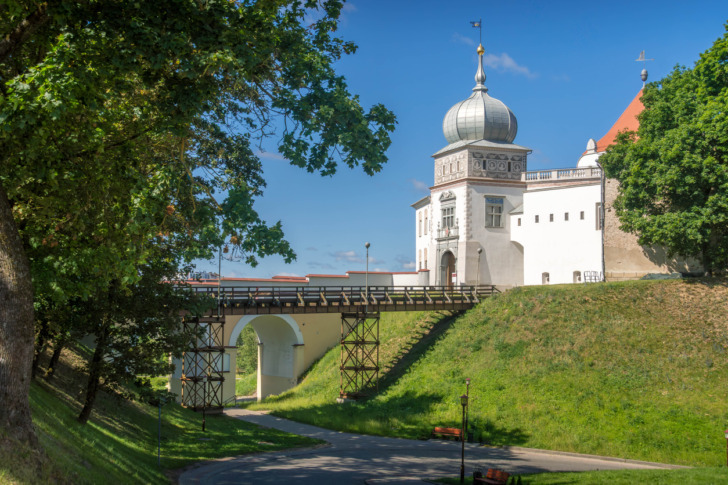
The Old Castle and neighboring New Castle dominate the Neman River and are among Grodno’s major historical attractions.
Visiting recognized museums and cultural sites during normal operating hours is much safer than independently exploring politically sensitive locations.
Stick to official visitor areas and avoid photographing nearby security personnel or infrastructure.
Cathedral of St. Francis Xavier
This impressive Baroque Catholic cathedral stands prominently in the historic center and is surrounded by active streets and businesses.
It is normally a comfortable daytime stop.
Dress respectfully, keep your voice low during services, and ask before photographing worshippers.
Religious buildings themselves are generally safe, although crowded holiday services require normal attention to belongings.
Kalozha Church
The 12th-century Kalozha Church overlooking the Neman River is one of Grodno’s most distinctive landmarks.
The surrounding park and river views are particularly pleasant during daylight.
The riverbank can become slippery in wet or icy weather, so stay on established paths rather than climbing down steep slopes for photographs.
Central Parks and River Walks During Daylight
Grodno has attractive green areas and walks overlooking the Neman.
These are normally peaceful during the day and provide a good break from museums and architecture.
Use more caution after dark, particularly on quiet sections away from streets and buildings.
In winter, paths may become icy even when central pavements have been cleared.
Places to Avoid in Grodno
Demonstrations and Political Gatherings
This is the most important area to avoid, even if a gathering appears completely peaceful.
Belarusian authorities have detained bystanders as well as participants during demonstrations, and foreign nationals are not automatically protected from arrest.
Do not photograph protests, security forces, arrests, flags, or political activity.
If a crowd begins forming, leave immediately rather than watching from nearby.
Military and Security Installations
Avoid military bases, government security buildings, checkpoints, police facilities, communications infrastructure, and anything that appears connected with the armed forces.
Do not photograph these sites.
Foreign visitors can face questioning or detention over behavior that might seem harmless elsewhere.
Belarusian Border Zones
Grodno is close to both Poland and Lithuania, which makes border restrictions particularly relevant.
Do not explore border roads, forests, fences, checkpoints, or restricted zones recreationally.
Crossings can close or change operating rules with little notice.
Never attempt to use an unofficial crossing or approach border infrastructure simply to look around.
Railway and Bus Station Surroundings Late at Night
The main transportation areas are normally safe during regular travel hours, but they are less appealing late at night.
Travelers carrying luggage are obvious newcomers and may attract unofficial drivers or opportunistic thieves.
Arrange transportation before arriving and move directly between the station and your accommodation.
Empty River Paths After Dark
The Neman River is one of Grodno’s nicest features, but quiet river paths are best enjoyed during daylight.
Some stretches become isolated after dark and may have limited lighting.
The risk is not exceptionally high crime.
It is simply unnecessary exposure when safer, illuminated streets are nearby.
Politically Sensitive Memorials or Events
Belarusian history and politics are sensitive subjects.
Avoid protests, unofficial memorial gatherings, political graffiti, opposition symbols, or events that appear connected to current political movements.
A foreign passport does not make political involvement consequence-free, and activities conducted outside Belarus may also receive scrutiny.
Safety Tips for Traveling to Grodno
- Understand that low crime does not mean low travel risk. This is the most important distinction in Grodno. You may walk through a clean, quiet center and feel completely safe from robbery, yet still face risks involving detention, border restrictions, or law enforcement. Several governments currently advise their citizens not to travel to Belarus at all.
- Stay completely away from political activity. Do not attend demonstrations, photograph rallies, display political symbols, or get involved in discussions with strangers about opposition movements or Belarusian politics. Authorities have detained people for political activities and online content. Simply observing a demonstration can create unnecessary risk.
- Be careful with your phone and digital history. Visitors should assume electronic devices and communications may be monitored. Foreign nationals have faced scrutiny based on information stored on phones or online accounts, including material created outside Belarus. Consider what information you carry digitally before crossing the border.
- Do not photograph military or government facilities. Avoid photographing soldiers, police, checkpoints, military vehicles, government offices, border infrastructure, or communications equipment. If an authority tells you to stop filming or delete an image, remain calm and comply with instructions rather than arguing.
- Have more than one exit plan. Grodno’s location near Poland and Lithuania might look convenient on a map, but international borders can close or become restricted unexpectedly. Do not rely on a single crossing, train, or bus connection. Keep enough money and medication to handle several days of unexpected disruption.
- Check border rules immediately before traveling. Rules between Belarus and neighboring EU countries have changed repeatedly. A crossing that appears on an old map or travel website may be closed to certain travelers or transportation types. Confirm your exact route before departure rather than assuming you can simply drive from Grodno into Poland or Lithuania.
- Carry identification and immigration documents properly. Keep your passport, visa or visa-free entry documentation, medical insurance information, and accommodation registration details organized. Foreign visitors staying beyond the required registration period must follow Belarusian registration rules, although hotels commonly handle registration for their guests.
- Use established hotels and transportation. A recognized hotel provides more than a bed. Staff can help with registration, taxis, transportation changes, and local procedures. Use official taxis or hotel-arranged drivers instead of accepting informal rides from strangers at stations or border areas.
- Keep conversations with authorities calm and minimal. If stopped by police or border officials, remain polite, provide requested documents, and avoid jokes, arguments, political commentary, or aggressive filming. Local law applies regardless of whether a visitor understands or agrees with it. Arbitrary enforcement is one of the main reasons Belarus currently carries serious travel warnings.
- Check that your travel insurance is actually valid. Some insurance policies become invalid or severely restricted when you travel to a country against an official government warning. Do not simply buy a standard European policy and assume Belarus is included. Confirm medical treatment, evacuation, political disruption, border closure, and regional conflict coverage in writing.
So... How Safe Is Grodno Really?
If we looked only at conventional crime, Grodno would probably receive a low-risk rating.
Crime levels in Belarus are relatively low, and street theft or violent attacks are not the primary reason travelers should think twice about visiting.
Grodno itself can look peaceful, organized, and surprisingly relaxed.
The problem is that travel safety is about more than whether someone might steal your wallet.
As of August 2026, several governments continue to advise against all travel to Belarus.
The concerns include arbitrary arrest and detention, unpredictable enforcement of laws, extremely limited consular assistance, restrictions on political expression, monitoring of electronic devices, border closures, and the possibility that conflict related to the war in Ukraine could affect Belarus.
Grodno’s western location adds another complication.
It sits close to Poland and Lithuania, but those borders cannot be treated like ordinary European crossings.
Restrictions have changed repeatedly, and some crossings have closed completely or operated only for certain categories of travelers.
So, how safe is Grodno really?
For street crime, fairly safe.
For the complete travel environment in 2026, high risk.
Grodno is historically fascinating and visually attractive, but ordinary leisure travelers should seriously consider postponing a visit until political conditions, border access, and international travel warnings improve.
How Does Grodno Compare?
| City | Safety Index |
|---|---|
| Grodno |
50 |
| Vitebsk |
54 |
| Gomel |
45 |
| Nesvizh |
55 |
| Brest |
48 |
| Minsk |
77 |
| Mogilev |
53 |
 Edirne Edirne | 72 |
 Chattanooga Chattanooga | 69 |
 Rajshahi Rajshahi | 68 |
 Zacatecas Zacatecas | 60 |
| Astoria | 85 |
| San Juan Islands | 83 |
Useful Information

Visas
Belarus has extended visa-free entry through December 31, 2026 for citizens of 38 European countries. Most covered travelers can stay up to 30 days per entry, with a maximum of 90 days during the calendar year. Polish, Lithuanian, and Latvian citizens have special provisions allowing stays of up to 90 days. Other nationalities may require an e-visa or conventional visa.

Currency
Grodno uses the Belarusian ruble. International banking restrictions mean foreign cards may not work consistently, even when the card network would normally operate abroad. Carry a practical cash backup and use ATMs inside established banks. Avoid unofficial currency exchange and do not depend entirely on one foreign credit or debit card.

Weather
Grodno has warm summers and cold winters. July and August are usually the warmest months, while December through February can bring snow, freezing temperatures, and icy pavements. Spring and autumn are variable and often wet. Pack layers and rain protection outside summer, and bring insulated waterproof footwear for winter trips.

Airports
Grodno Airport is located outside the city but has only limited scheduled services. Minsk National Airport remains Belarus’s main international aviation hub, although international flight choices are considerably reduced compared with the period before 2022. Grodno also has rail and road connections, but cross-border options can change without warning.

Travel Insurance
Travel insurance requires special attention for Belarus. Policies may exclude coverage when travelers enter against government advice, and ordinary European policies may not cover political detention, conflict-related disruption, sanctions-related problems, or emergency evacuation. Confirm coverage directly with the insurer before traveling and obtain written confirmation that Belarus is included.
Grodno Weather Averages (Temperatures)
Average High/Low Temperature
| Temperature / Month | Jan | Feb | Mar | Apr | May | Jun | Jul | Aug | Sep | Oct | Nov | Dec |
|---|---|---|---|---|---|---|---|---|---|---|---|---|
| High °C |
1 | 2 | 6 | 14 | 20 | 23 | 25 | 24 | 19 | 12 | 6 | 2 |
| Low °C |
-5 | -5 | -2 | 3 | 8 | 11 | 14 | 13 | 9 | 4 | 0 | -3 |
| High °F |
34 | 36 | 43 | 57 | 68 | 73 | 77 | 75 | 66 | 54 | 43 | 36 |
| Low °F |
23 | 23 | 28 | 37 | 46 | 52 | 57 | 55 | 48 | 39 | 32 | 27 |
Belarus - Safety by City
| City | Safety Index |
|---|---|
| Brest | 48 |
| Gomel | 45 |
| Grodno | 50 |
| Minsk | 77 |
| Mogilev | 53 |
| Nesvizh | 55 |
| Vitebsk | 54 |