


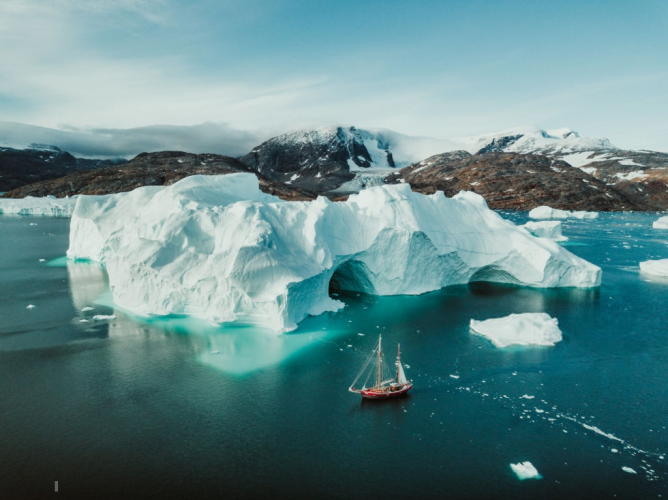
Greenland is a vast Arctic island located between Canada and Iceland, and though it is part of the Kingdom of Denmark, it operates with a high degree of self-governance.
Indigenous Inuit communities have lived here for thousands of years, followed by waves of Norse settlement, Danish colonization, and modern autonomy movements.
Today, about 150,000 travelers visit each year.
That might sound small, but once you realize the largest city, Nuuk, has around 19,000 residents and there are no roads connecting cities, it makes sense.
Most visitors travel by boat or small plane, and about two-thirds of travelers arrive by cruise ship.
You might wonder why a place covered in snow and ice is called Greenland.
History proves to have a sense of humor here.
When Erik the Red arrived in the late 900s, Iceland already had its name and reputation.
He chose “Greenland” to sound more inviting to potential settlers.
FYI: Parts of the southern coast do turn green in summer, but mostly, the name was early real estate marketing.
Greenland’s landscapes are the main draw.
Nearly 80 percent of the country is covered by ice, and the rest is dramatic coastline, fjords, tundra, and rocky mountains.
Visitors come to see massive glaciers calving into the sea, watch icebergs drift through Ilulissat Icefjord, and take guided hikes across ancient rock that predates almost everything on Earth.
Wildlife sightings are part of the experience.
Depending on where you go, you may encounter whales, seals, muskoxen, reindeer, and, in some regions, polar bears.
The scale is immense, the silence is real, and the sense of being somewhere untouched is what makes Greenland unforgettable.
It’s also the part of the trip that brings the most risks.
Warnings & Dangers in Greenland

OVERALL RISK: LOW
There's a low risk in Greenland, but be sure you understand the rugged, wild, and risky landscapes here before planning a trip. Every concern that raises an eyebrow is tied to the natural landscape or weather.

TRANSPORT & TAXIS RISK: LOW
You're going to need to be okay with small planes or boats to get around Greenland, because there aren't roads connecting cities. Local transportation options in places like Nuuk and Sisimut are safe, and don't assume that a small town means "walkable." Some are several miles from end to end. You might even consider that a snowmobile or a dog sled will be the easiest way to get around. The risk is low, but know that this isn't a typical "how to get around" kind of place.

PICKPOCKETS RISK: LOW
This is a low-risk risk, and crime is almost nonexistent here. That doesn't mean you should let your guard down, but it helps to know that while you're watching out for polar bears, you don't need to be worrying about your backpack getting ransacked by a thief.

NATURAL DISASTERS RISK: MEDIUM
This is a medium risk, but probably not in the way you'd think. Yeah, it's cold, and the weather can change. You'll face some of the worst risks of winter weather compared to any other place on earth. Plus, add in the dynamics of calving icebergs, crevasses that drop deep into the glacier, and ice-cold weather surrounding your water journey, and you'll see why warm layers and waterproof jackets and clothing are essential. Even going hiking in the snow without goggles or glasses can leave your eyes permanently damaged.

MUGGING RISK: LOW
This is another low risk, as violent crime is even less likely than petty theft. In fact, Greenland even has a victim compensation fund if you do happen to be a victim of a crime.

TERRORISM RISK: LOW
The polar bear will be the biggest "terrorist" you'll see here, as this is a low-risk category in this massive country with a small population.

SCAMS RISK: LOW
This might be the first country I've seen that has no travel advisories about scams. That's the good news. However, don't let your guard down. Stick with vetted tour guides. Expect things to be pricey here because getting supplies isn't cheap.

WOMEN TRAVELERS RISK: LOW
Women face a low risk, like anyone else, but should abide by all the standard safety regulations. Ladies, this isn't a place you want to put fashion over comfort. Bring rugged footwear, clothing, and plenty of layers.

TAP WATER RISK: LOW
The tap water risk is low in Greenland, as it's known to have some of the best water on Earth!
Safest Places to Visit in Greenland
The official tourism website is visitgreeland.com.
You can trust the information on that website as the government tourism sector runs it.
Cruise visitors often arrive in Nuuk, Ilulissat, Sisimiut, Qaqortoq, or Narsaq.
Nuuk, the capital, is on the southwest coast and has museums, cafes, and easy access to guided fjord cruises.
Ilulissat, farther north, sits beside Ilulissat Icefjord, a UNESCO site known for massive, slow-drifting icebergs.
Boat tours and scenic helicopter flights are the highlights there.
Sisimiut offers coastal hiking and strong cultural heritage experiences with dog sledding and boat trips, depending on the season.
Qaqortoq and nearby Narsaq in South Greenland give you colorful towns, Norse history sites, and a gentler landscape suited for easy walks and short boat trips.
If you are flying in, most travelers connect through Kangerlussuaq before moving on to their final destination.
Kangerlussuaq has direct access to the inland ice sheet, so guided ice cap tours are common here.
Nuuk is the administrative and cultural center, with art museums, harbor trips, and local food experiences.
Travel between towns usually happens by small plane, helicopter, or seasonal boats.
There are no roads linking communities, so plan your route before booking lodging.
For land-based trips, guided hikes, coastal walks, and fjord boating are the main activities.
Weather can change schedules, so keep plans flexible.
Places to Avoid in Greenland
Greenland is huge, about the size of Alaska, but with only a handful of towns and no roads connecting them.
You know, much like Alaska!
However, if you think Alaska is remote and rugged, wait until you see Greenland.
Everything in between the small towns is wilderness.
That means the places to “avoid” are less about neighborhoods and more about knowing your limits.
Stay out of remote terrain without an experienced guide.
Ice sheets, glaciers, and fjords can look wide open and safe, then shift, crack, or drift without warning.
Do not approach wildlife.
Polar bears are powerful and unpredictable, and muskoxen can be territorial.
Even seals can be aggressive.
Keep your distance, watch quietly, and respect the fact that you are in their home.
Sled dogs deserve special attention.
They are working animals, not pets.
Do not touch or call them unless a musher explicitly invites you, which is rare.
I will admit, this one would be hard for me because I love dogs, but here it is simply part of respecting the culture and the animals’ purpose.
Safety Tips for Traveling to Greenland
- The local police are known as the Greenland Police, and they handle both community policing and emergency response. For immediate help, dial 112, which connects you to police, fire, or medical services. Response times can vary, especially outside major towns. If you’re heading into remote areas, guides and tour operators often maintain direct radio or satellite contact with local authorities.
- There is no widespread text alert system for travelers. The best way to stay informed is to monitor local radio, follow municipal Facebook pages, and check with your hotel or tour operator. Weather and sea conditions change fast here. If you’re cruising, rely on the ship’s briefing system. If you’re on land, ask for updates before every excursion.
- Foreign nationals can drive in Greenland with a valid license from home, but driving is usually limited to short distances within towns. There are no roads connecting one community to another, so vehicles are not used for long-distance travel. Most movement between towns happens by boat, plane, or helicopter. If you rent a vehicle, be cautious of icy roads and limited street lighting.
- No mandatory vaccinations are required for entry, but routine travel vaccines like Hepatitis A and B, and updated tetanus, are helpful. Medical care is limited outside larger towns, so traveling in good health matters. If you plan to camp, hike, or handle raw fish while angling, having basic boosters and travel health insurance is a smart move.
- Greenland does not have a single emergency medical hotline. Instead, medical facilities are reached through local clinic numbers. Keep the Greenlandic Healthcare System telephone list with you, especially when traveling outside a main town. If something happens, seconds count, and you do not want to be searching for contact information in the moment.
- The official language is Greenlandic, and Danish is widely spoken. English is common in tourism, especially among guides and in hotels. You’ll manage most conversations easily in visitor-facing areas. In smaller settlements, communication may involve more gestures and patience, but people are friendly and used to travelers.
- Internet service is available in most towns, but expect slower speeds and occasional outages due to weather and infrastructure limitations. Buy local data if you need reliable access, and download offline maps. Remote communities may have limited connectivity or none at all. Plan communication, especially if heading into wilderness zones.
- Greenland strictly regulates natural resource extraction. Do not pick up stones, minerals, or attempt to collect gemstones without official permission. Many traditional handicrafts are made from seal, whale, or bear products. These are legal to buy locally, but may be illegal to bring back into your home country. Check customs laws before purchasing souvenirs to avoid confiscation.
- Summer is bug season, and the mosquitoes and midges are relentless near wetlands and fjords. Bring strong repellent, a head net, and lightweight long sleeves. This is not a mild nuisance. Even locals gear up for it. A head net will make the difference between enjoying a hike and sprinting back to your lodging, swatting the air.
- If you plan to kayak, wear a wetsuit even in summer. The ocean and glacial waters are extremely cold year-round. Falling in without proper insulation can lead to hypothermia in minutes. Outfitters usually provide gear, but double-check before booking. The scenery is unforgettable, but respecting the water temperature is part of staying safe.
So... How Safe Is Greenland Really?
If you’re visiting Greenland, there’s a higher than average chance you’re arriving by cruise ship.
That lowers the risk factor for most activities, since you’ll likely be on an excursion or with a group while you’re in a port city.
The United States lists Greenland at the elected risk Level 2.
That means exercising increased caution, but not due to crime or other human hazards.
Nature is the real risk factor here.
Cold isn’t just cold here.
Wind chill can be extreme, hypothermia can set in fast, and the bright snow can cause snow blindness if you’re not wearing proper eye protection.
Glaciers and ice sheets shift and crack without warning, so glacier hikes should only be done with licensed guides.
Out on the water, tides change quickly, and floating ice can trap boats or block a route back to shore.
Even calving icebergs can cause tsunamis in coastal cities.
If a crime does occur, Greenland has a victim compensation fund that can assist with financial recovery.
It’s not common for travelers to need it, but it’s good to know the resource exists.
In short, stay aware of your surroundings and take nature seriously, and most visitors have a very safe experience.
How Does Greenland Compare?
| Country | Safety Index |
|---|---|
 Greenland Greenland | 80 |
 South Korea South Korea | 86 |
 Czech Republic Czech Republic | 88 |
 Kuwait Kuwait | 74 |
 Mauritius Mauritius | 80 |
 Puerto Rico Puerto Rico | 48 |
 Australia Australia | 86 |
 Bulgaria Bulgaria | 80 |
 Ireland Ireland | 83 |
Useful Information

Visas
It depends on the nationality whether you need a visa or not, but all the required information is clearly provided by the web-site of the public authorities.

Currency
The official currency is the so-called Greenlandic krone.

Weather
Greenland has in the north-central zone arctic climate where the average temperature of the warmest months is considered to be close to freezing and in the south-central zone subarctic the hottest registered temperature is a little bit above freezing.

Airports
As it is a really big island, there are 14 airports one can have flights from.

Travel Insurance
As it is always recommended to have travel insurance while traveling, no matter the destination Greenland is not an exception.
Greenland Weather Averages (Temperatures)
Average High/Low Temperature
| Temperature / Month | Jan | Feb | Mar | Apr | May | Jun | Jul | Aug | Sep | Oct | Nov | Dec |
|---|---|---|---|---|---|---|---|---|---|---|---|---|
| High °C |
-10 | -10 | -9 | -4 | 4 | 9 | 12 | 10 | 5 | 0 | -4 | -8 |
| Low °C |
-17 | -18 | -17 | -13 | -3 | 3 | 5 | 4 | -1 | -6 | -11 | -14 |
| High °F |
14 | 14 | 16 | 25 | 39 | 48 | 54 | 50 | 41 | 32 | 25 | 18 |
| Low °F |
1 | -0 | 1 | 9 | 27 | 37 | 41 | 39 | 30 | 21 | 12 | 7 |










Very Safe
Excellent, very safe from Covid 19. Just like in Plague Inc
One to visit
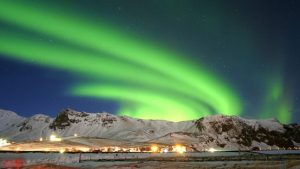
From whale watching to seeing the Northern Lights, Greenland over delivered. Wife booked a surprise trip with me being a bit reluctant at first and then, as I googled things to do there, being completely over the moon. I didn’t feel unsafe at all, everything was perfectly organized. The locals were the cherry on top, culturally diverse and so cheerful and pleasant.
My trip in Greenland it gave a clear sense of how remote and wild the terrain is, and why nature not people is the real risk. That context helped me pack smarter and plan hikes with a guide.
Experiencing that kind of vastness and silence is something else; it really makes you feel small in the best way.
It’s really something to stand in such vast, untouched landscapes and feel the absolute stillness around you; it makes you realize how small we are in the grand scheme of things.
I’ve been on one of those cruise ships there and while the views were incredible, the constant rocking of the boat and the freezing wind really took the fun out of it for me.
I never thought I’d get chills from just the silence, but standing near those giant glaciers calving into the sea definitely did it for me.
Have you ever had a moment where the silence there felt almost too intense, like it was its own kind of noise?