


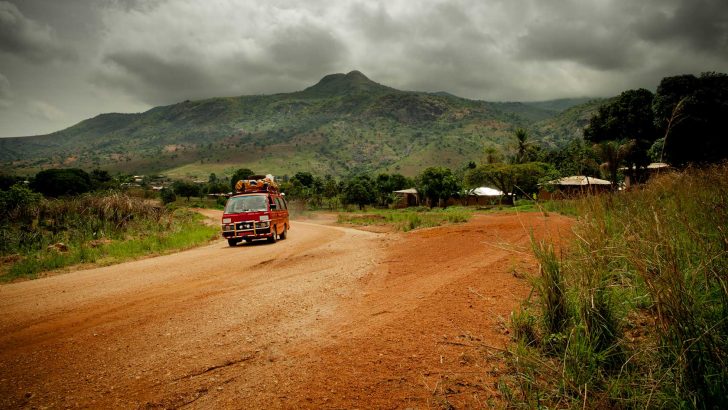
Cameroon is often called “Africa in miniature,” and that’s because you can find beaches, rainforests, savannas, and mountains all packed into one country.
Located on the Gulf of Guinea in Central Africa, it borders six nations and stretches from the Atlantic coast to Lake Chad in the north.
Its history is complex.
After German colonization in the late 1800s, Cameroon was later split between the French and British until independence in 1960.
Today, tensions between Anglophone and Francophone regions have fueled conflict in recent decades.
Add in instability from neighboring countries and extremist groups exploiting porous borders, and it’s easy to understand why parts of Cameroon carry serious safety warnings.
Tourism here has never been a leading industry, and recent unrest has limited growth further.
Still, around one million people visit each year, drawn by the country’s remarkable variety.
Some come for trekking on Mount Cameroon or to relax on the sandy beaches near Kribi.
Others seek wildlife encounters in rainforests or to experience the cultural traditions of Cameroon’s many ethnic groups.
At the same time, the “Africa in miniature” can also summarize the risks, as the list of safety issues is as long as the things to do.
Maybe even longer.
Warnings & Dangers in Cameroon

OVERALL RISK: MEDIUM
There's a medium risk in Cameroon, and the list of reasons why is long. While you shouldn't check this off your bucket list, keep reading to see what the challenges are that you might face while you're there.

TRANSPORT & TAXIS RISK: MEDIUM
Transportation comes with a medium risk, too. Don't use public transportation here. Violent assaults in taxis have been reported often. You'll need to hire a driver through a private company. If you choose to drive yourself, you'll face poorly maintained roads, potential washouts during the rainy season, and aggressive drivers.

PICKPOCKETS RISK: MEDIUM
This is a medium risk as theft is far too common, especially in places frequented by visitors. Most are crimes of opportunity, so you'll need to keep your wits about you.

NATURAL DISASTERS RISK: LOW
Cameroon faces natural risks tied to its geography. Volcanic activity around Mount Cameroon and Lake Nyos poses rare but serious threats, including toxic gas releases. Seasonal floods and landslides can disrupt travel, especially during heavy rains from May to October. Stay up to date on the forecast, and you can keep the risk low.

MUGGING RISK: MEDIUM
This is a medium risk, and government advisories prove that criminals here aren't afraid to use violence to get what they want. Don't ever resist a robber demanding valuables or money.

TERRORISM RISK: HIGH
Terrorism in Cameroon stems mainly from extremist groups operating along porous northern borders, particularly spillover from Boko Haram in Nigeria. These groups exploit weak security and remote terrain to stage attacks, kidnappings, and raids. Combined with limited government control in these areas, the risk of violence remains high and unpredictable. Read travel advisories for specific incidents that have impacted tourists.

SCAMS RISK: HIGH
Scams are widespread in Cameroon, especially online. Fraudsters often pose as stranded travelers, business partners, or romantic interests, creating emotional stories to pressure victims into sending money. Fake investment opportunities and advance-fee schemes are also common. Once you arrive in Cameroon, scams can still happen, but you should be much more worried about violent crimes.

WOMEN TRAVELERS RISK: HIGH
Women traveling in Cameroon may face added risks, including harassment, unwanted attention, and limited legal protections in some areas. Solo travel can increase vulnerability, particularly at night or in crowded places. Dressing conservatively and arranging trusted transport helps reduce exposure. Traveling with groups or guides offers an extra layer of safety.

TAP WATER RISK: HIGH
Tap water in Cameroon is generally unsafe to drink. Contamination risks from bacteria, parasites, and poor infrastructure are common, even in major cities. Stick to bottled or boiled water for drinking and brushing teeth. Ice and raw produce washed in tap water can also carry risk, so choose carefully when dining out.
Safest Places to Visit in Cameroon
When looking for the official tourism website, search for “Ministry of Tourism and Leisure in Cameroon.”
The website isn’t secure as of this publication, so don’t give any personal information while visiting it.
There’s another site called Discover Cameroon (and also spells it Cameroun), but you should know that it is a tour company.
While we can’t guarantee any of the places in Cameroon are safe, here are the spots that draw the most visitors.
The coast delivers golden beaches and lively port cities like Douala, where markets and seafood dominate the scene.
Inland, Yaoundé blends its role as the capital with cultural stops such as the National Museum and hillside neighborhoods worth exploring.
Mount Cameroon, the highest peak in West Africa, draws hikers and adventure seekers, while the surrounding trails offer accessible options for less seasoned climbers.
If wildlife is your focus, head to Lobéké National Park or Dja Faunal Reserve, both UNESCO-listed and home to elephants, gorillas, and birdlife.
For a change of pace, the western highlands around Bamenda bring cooler weather, craft markets, and rolling hills dotted with traditional villages.
Lake Nyos and other crater lakes nearby offer striking landscapes unlike anywhere else.
Along the coast, Kribi is a favorite for its beaches and the impressive Chutes de la Lobé waterfall, where the river meets the Atlantic.
Places to Avoid in Cameroon
Oof.
You might want to sit down for this one.
It’s a long list.
While most of the country has an overall rating at Level 2 (on a four-tiered scale), many regions rise to Level 3 or 4, which tops out as a “Do Not Travel” guidance from other governments.
Many of the regions with higher travel advisories border unstable countries or are tied up in local conflicts.
Armed groups exploit weak border security, moving between countries with little oversight.
In other places, separatist movements and clashes with government forces pose a danger.
It’s less about random crime and more about organized groups operating in remote, poorly controlled areas.
The United States lists the following regions as DO NOT TRAVEL:
- North
- Far North
- Northwest
- Southwest
- Parts of the East and Adamawa Regions
While these might overlap with some of those regions, the UK’s FDCO lists the following as places to avoid all travel:
- Bakassi Peninsula
- Cameroon-Central African Republic border
- Cameroon-Chad border
- Cameroon-Nigeria border
- Lake Nyos (due to carbon dioxide risks)
Canada explains the places to avoid in these words:
- Far North region and Mayo-Louti Department
- Borders with Nigeria, Chad, and the Central African Republic
- North-West and South-West regions
- North and Adamaoua regions (Level 3/Avoid Non-Essential Travel)
I mapped all that together, and if you look at Cameroon on a map, the areas to avoid are anywhere to the north, west, or east where there’s a border with another country.
Also, draw an imaginary line below M’Bakaou Reservoir, and everything north of there should be avoided.
Safety Tips for Traveling to Cameroon
- Cameroon’s national police handle most emergencies, with gendarmes covering rural areas. In cities like Yaoundé and Douala, response times can be inconsistent. The nationwide emergency number is 117, though reliability may vary. If you need help, contact your hotel or embassy immediately after calling, as they can often provide faster and more reliable support.
- Cameroon does not have a formal public alert system like text-based warnings. Major events are usually communicated through local radio, television, or word of mouth. Travelers should keep a battery-powered radio on hand and check embassy websites and social media for updated information. Signing up for the U.S. State Department’s STEP program can help you receive alerts directly.
- Foreign visitors can drive in Cameroon with their home license. Roads are often poorly marked, and police checkpoints are common, so keep documents accessible. Vehicle quality and road conditions vary greatly, especially outside cities. If you aren’t driving yourself, we strongly recommend that you get private transportation from a reliable source.
- The Hilton and Mont Fébé hotels run shuttles from Yaoundé-Nsimalen Airport to downtown, and they are among the safest ways to get into the city. If it helps you decide where to stay, know that these hotels give you a far more secure option than anything you will find in hailing a taxi on the street.
- A yellow fever vaccination is required for entry into Cameroon, and travelers must carry proof. The CDC also recommends routine immunizations plus hepatitis A, typhoid, and meningitis. Malaria prevention is critical, and chemoprophylaxis is advised even for short trips. Consult a travel health provider before departure, as requirements and local disease risks can change quickly.
- French is the official language in most of Cameroon, while English is widely spoken in the Northwest and Southwest regions. In major cities, some service workers may understand basic English, but communication can be difficult in rural areas.
- Online scams are rampant in Cameroon, often involving fabricated relationships or financial distress stories. Scammers pose as stranded U.S. citizens or businesspeople needing urgent help. They rely on emotional manipulation and pressure to send money. Do not respond to unsolicited messages or transfer funds to anyone you have not met in person.
- Photography is tightly controlled. Do not take pictures of government buildings, military areas, airports, or other facilities, as many are unmarked. Violators risk fines, detention, or confiscation of equipment. Always ask permission before photographing individuals, even in markets or villages. Discretion is your safest approach, as ignorance of the rules is not considered a valid defense.
- Cell phones are the main form of communication in Cameroon. Travelers can buy a local SIM card with a passport, provided their phone is unlocked and compatible. Coverage is decent in large cities but can drop without warning, especially in remote regions. Keep backup communication options if traveling into rural areas.
- Cameroon strictly prohibits buying, selling, or trading in protected wildlife or products such as ivory without a license. Poaching remains a serious issue, and penalties for violations include fines or imprisonment. Avoid markets selling animal parts, even as souvenirs. Supporting legitimate ecotourism efforts helps conservation while keeping you on the right side of the law.
So... How Safe Is Cameroon Really?
Cameroon comes with a slew of safety advisories, and you must check the latest travel advisory to see if it’s gotten safer or more dangerous.
As of late 2025, Cameroon largely gets a Level 2: Exercise Increased Caution travel advisory from countries like the United States, Australia, and Canada.
That’s the second-lowest on a four-tiered rating scale.
However, as mentioned earlier, there are specific regions that go as high as Level 4: Do Not Travel.
Even with the Level 2, the risks are numerous.
The United States specifically mentions:
- Armed violence
- Civil unrest
- Crime
- Health
- Kidnapping
- Terrorism
The higher-risk areas include issues like kidnapping, murder, and terrorist attacks.
Even if you get there safely, there are risks for things like using taxis, and services can be shut off without notice, leaving you stranded.
What safety in Cameroon comes down to is, how comfortable are you with “What If?”
No matter what your tolerance level is for traveling to higher-risk locations, I encourage everyone to read the Canadian travel advisory before the trip.
I find that one tends to be the most granular, down to highways and parts of town that might have more dangers than you realize.
Since the tourism industry is unevenly regulated, it’s imperative that you vet any tour guide and look for sanctioned companies and transportation.
There are African countries that have a lot more risk factors, but there are also safer places to visit.
You can read more on our website to find the perfect spot in Africa to visit that matches your risk and comfort levels.
How Does Cameroon Compare?
| Country | Safety Index |
|---|---|
 Cameroon Cameroon | 36 |
 Uruguay Uruguay | 77 |
 Somaliland Somaliland | 58 |
 Somalia Somalia | 16 |
 Niger Niger | 37 |
 Republic of the Congo Republic of the Congo | 54 |
 Chile Chile | 79 |
 Brunei Brunei | 80 |
 China China | 66 |
Useful Information

Visas
Most travelers need a visa to enter Cameroon, which must be arranged before arrival through an embassy or consulate. Tourist visas usually cover up to 30 or 90 days, depending on approval. Requirements often include proof of yellow fever vaccination, hotel reservations, and sufficient funds. Processing times vary, so apply several weeks in advance.

Currency
Cameroon uses the Central African CFA franc (XAF), a stable regional currency pegged to the euro. Credit cards are not widely accepted, so cash is essential for most purchases. ATMs are common in major cities like Douala and Yaoundé but less reliable in rural areas. Exchange bureaus and banks offer services, though rates vary.

Weather
Cameroon uses the Central African CFA franc (XAF), a stable regional currency pegged to the euro. Credit cards are not widely accepted, so cash is essential for most purchases. ATMs are common in major cities like Douala and Yaoundé, but less reliable in rural areas. Exchange bureaus and banks offer services, though rates vary.

Airports
Douala International Airport is the busiest gateway, followed by Yaoundé Nsimalen International Airport. Both connect to regional hubs like Nairobi, Addis Ababa, and Paris. Smaller domestic airports serve Maroua, Garoua, and Ngaoundéré. Facilities may feel outdated compared to other international airports, so expect basic services and limited dining or shopping options.

Travel Insurance
Travel insurance is strongly recommended due to Cameroon’s healthcare limitations. Comprehensive policies should cover medical evacuation, trip interruptions, and theft, as hospitals often require upfront payment. Risks such as road accidents, malaria, and unpredictable travel disruptions make coverage especially important. Confirm that your policy specifically includes Central Africa, as some exclude higher-risk destinations.
Cameroon Weather Averages (Temperatures)
Average High/Low Temperature
| Temperature / Month | Jan | Feb | Mar | Apr | May | Jun | Jul | Aug | Sep | Oct | Nov | Dec |
|---|---|---|---|---|---|---|---|---|---|---|---|---|
| High °C |
29 | 31 | 29 | 28 | 28 | 28 | 27 | 27 | 28 | 29 | 30 | 30 |
| Low °C |
20 | 20 | 20 | 20 | 19 | 19 | 19 | 19 | 19 | 20 | 20 | 20 |
| High °F |
84 | 88 | 84 | 82 | 82 | 82 | 81 | 81 | 82 | 84 | 86 | 86 |
| Low °F |
68 | 68 | 68 | 68 | 66 | 66 | 66 | 66 | 66 | 68 | 68 | 68 |












Dangerous
There Are Disasters Hitting Cameroon And Cameroon Is Not That Safe For Travelers
This are lies by ignorant people
This is not the best way to portray a country you idiots go take pictures of better places rather than show than that trash up there. Inform yourselves about the country before making such assumptions
i have lived in Cameroon none of this has happened to me. the only thing right here is terrible roads but not reckless drivers
Um, that is a lie. i went to Yauonde and the drivers were INCREDIBLY reckless.
Don't go to Cameroon
My Dad went to cameroon about ten years ago. He went to help an American man with some construction in a jungle area. My Dad was robbed shortly after getting off the plane. Then later ..all of the construction equipment was stolen. It doesn’t sound like a fun place to visit to me. I’m grateful that my Dad made it home in one piece.
Safety
I am sorry to hear about your dad’s situation, but if we rely on your story, then is as good as telling everyone not to go the United State of America because the level at which theft and killings are happening is above all. Overall, Cameroon would still be a better choice. Once again, I am sorry of about what your dad went through. It could have been wrong place, wrong time.
“I am sorry of about what your dad went through. It could have been wrong place, wrong time.” Spot on, wrong place (Cameroun) and wrong time (any time).
Anybody see the see the Women’s World Cup match in 2019 GB v Cameroun? If that’s how they behave in an international match in France imagine what they’re like at home!
Cameroon is Africa in miniature, it’s just that we lack good governance
Please, do proper research before rating or writing falsely about Cameroon because there are other factors to consider when doing a survey, thank you.
Please, do proper research before rating or writing falsely about Cameroon because there are other factors to consider when doing a survey, thank you. If you think that way, then it is as good as you telling Cameroonians not to ever travel to the U.S.A because it is no better than Cameroon in-terms of what you described, if not worse. Once again, I am sorry about your dad’s situation. It was just being at the wrong place at the wrong time.
You’re probably a fool all you know is typing and giving the audience with wrong information of a country I thinks you’ve never for once or will ever be there cameroon is my country we thousands of foreigners here who came for tourism and latter on settle here
Dont portraits a country by assumption I will advertise you to edit your write up do proper search before writing down trash
guide me
am getting the opportunity to go and work there ..is it safe there brother people are confusing me.
How safe is Cameroon for Canadians to travel to? My daughter is marrying a gentleman from Cameroon and we are planning a second wedding there.
Is it safe to travel there for Canadians ??
Cameroon is a safe place, people here are very very welcoming trust me.
That may be the creepiest "trust me" ever
Um yes don’t trust him
Kaboola
I don’t trust anyone but God
Don’t bother he is only marrying her for a visa , once he gets that it will be the last she sees of him
Okay Cameroon is not safe safe but most of the info written is totally false
Come and see Africa in miniature
How does one rate a when you don’t even have an agent tagged to this article? If you don’t know a place, be silent. Every country has its pros and cons and Cameroon is no difference as much as China, England, America, Brazil and the rest. Cameroon is a good place to visit. If you want to travel to Cameroon, make an online friend. It could help you a great deal.
“Summers are pretty rainy,,,,”
In Cameroon, you only have two seasons – “Wet” and “Dry” seasons. They do not have a summer season, per se.
Cameroon is a ****hole dirt poor country. Don’t ever visit the cesspool.
A great place to visit and to live in.
Cameroon is the most welcoming country in earth. In Cameroon, foreigners are king. And this is so true.
Yes there are drunk drivers in Cameroon, yes traffic signs are not everywhere, yes there are petty theft , malaria and others issues. But the above descriptions are not to paint the accurate picture of that beautiful and generous country which is indeed “Africa in miniature” due to its landscape, demographic, diverses populations, languages, cultures and much more. If you travel to Cameroon with the idea that people there will let you disrespect them like you guys do in other places in Africa, you may get away with that but not all the time. Folks there are very very open minded. They might be or look poor. Please don’t let that fool any potential abuser!!!! They are very very well educated people. The high school diploma gives the equivalent of US associate degree ok? The average cab driver has a master degree, and some are even PHD. Political setbacks have led that beautiful country in the path of economic despair, social discontent, and a clouded horizon when it comes to development and social outlook. That country has been under the rule of a tribal dictatorial regime for four decades. But these folks are very resilient. The world knows that when that regime collapses it will be a different ballgame for Africa. For Cameroon is a leading force in Africa in many ways. It is said that the latest my be the problem it face as foreign predators view a free Cameroon as the ignition that will trigger the liberation of the sub saharian Africa. The food in Cameroon is second to none. The sport is in their DNA as that small country represents the continent in many major sports at the international level. That right there can give an idea what that country mind is made of. Something to think about.
Enquiry
Hi friends,
I got a job on Cameroon. Two year contract. What is your opinion on whether or not to join the job. Please tell, whats the story of the Cameroon …..
Bad place
I will admit I have never been to Camaroon, nor any other place in Africa. My fiancé is in Camaroon working. Their worksite has been invaded by bandits and thieves. He is afraid for his life and so am I.
Cameroon has loads of bandits in all her cities.
This has been so since the year 2010.
Good people.
Cameroon is a beautiful place. People are nice and the food is great. Yeah, you do have to be mindful of things in some areas. Like you don’t want to be walking around with your phone in your hand. It’s that element in some places, especially in crowded places. But nothing close ever happen to me while there. I went to Yaounde last year.
My wife is from Limbe. I didn’t go to Limbe because of the Civil unrest. But I look forward to going maybe next time. It was refreshing not to see many fast food chains too.
Yaounde is a beautiful place with rolling hills, red-ish soil, tropical plants and great food and hospitality. Some of the nicest people I’ve ever met.
Can’t wait to go back.
This place travel safety write up gave a realistic look at serious concern like crime, kidnapping, unstable regions, and health risks especially around borders and big cities. It made me think twice about planning a trip without deep research and strong local contacts.
It’s fascinating how a country can be so rich in diversity yet face so many challenges; I can’t help but wonder how the locals feel about the influx of tourists and if they see it as a positive or just another layer of complexity in their lives.
I was exhausted after a trek up Mount Cameroon and then had to keep an eye on the safety warnings and porous borders, so yeah, totally the relaxing getaway I signed up for.
I went to Mount Cameroon once and while the views were breathtaking, I definitely felt the tension in the air with all the unrest people warned about.
Been there a few times and the mix of landscapes really sticks with you, but honestly, the tension between regions does make it tough to feel completely at ease when you’re out exploring, especially after sunset.