


Remote frontiers often attract travellers seeking places where local history and geography still shape daily life in many ways.
Ancient trade corridors, isolated valleys, coastal settlements, and desert towns continue adapting to conditions that have influenced daily life for generations.
Cultural traditions remain closely tied to temples, markets, religious festivals, old transport routes, and neighbourhoods where traditional crafts still form part of everyday life.
The following destinations rarely feel overly polished, yet their remote settings and deep cultural traditions continue to attract travellers looking for experiences shaped by local life and history.
Ancient Silk Road Cities and Desert Landscapes in Uzbekistan
Uzbekistan’s Silk Road cities still carry traces of the trade routes that once connected Central Asia with Persia, China, and the Mediterranean.
In Samarkand, Registan Square remains the main landmark, framed by blue-tiled madrassas that change colour throughout the day as the desert light shifts across the mosaics.
Around Siyob Bazaar near the Bibi-Khanym Mosque, vendors stack round loaves of bread beside dried apricots, pistachios, and spices brought in from nearby regions.
Tashkent feels more modern, though Chorsu Bazaar stays busy from early morning with produce sellers, butchers, and tea stalls beneath its large domed roof.
One of the best ways to experience the country is to plan Uzbekistan walking holidays that include destinations such as Samarkand, Bukhara, and Khiva, where it becomes easier to explore caravanserais, narrow alleys, and local neighbourhoods beyond the main monuments.
In Bukhara, stone streets around Lyabi-Hauz pass small workshops producing embroidery, ceramics, and handwoven carpets.
Khiva’s Itchan Kala district still feels remarkably preserved within its mud-brick walls, particularly around Islam Khodja minaret and the old city gates near sunset, when the heat finally begins to ease.
Rugged Highlands and Historic Monasteries in Bhutan
Bhutan’s mountain terrain shapes almost every part of daily life.
Roads curve through steep valleys lined with pine forest, suspension bridges, and clusters of whitewashed homes built against the hillsides.
In Thimphu, traffic lights never fully replaced the hand-directed intersections in the city centre, and the weekend market near the Wang Chhu River fills with chillies, yak cheese, dried fish, and woven fabrics brought down from rural districts.
Prayer flags cover hillsides throughout the country, especially near mountain passes like Dochula, where rows of memorial chortens stand above the clouds on colder mornings.
Paro remains one of Bhutan’s most visited areas because of Tiger’s Nest Monastery, which sits high above the valley on a rocky cliff face.
The trail climbs steadily through forested slopes lined with prayer wheels and small shrines.
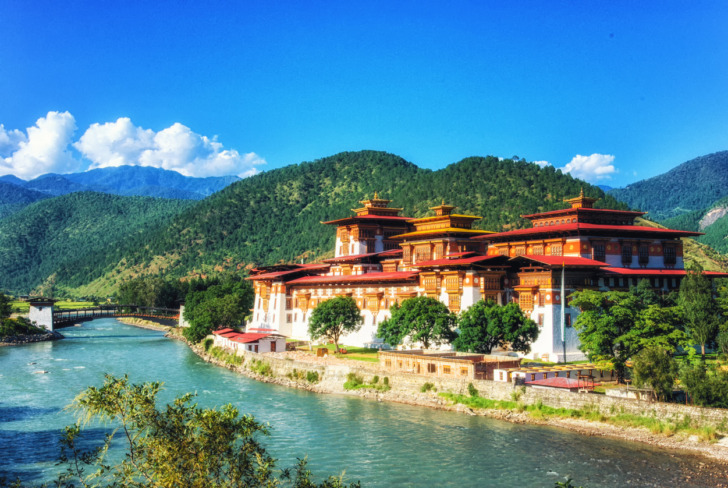
Farther east, Punakha Dzong sits beside the Pho Chhu and Mo Chhu rivers, surrounded by jacaranda trees during spring.
Monks in crimson robes cross the wooden bridges daily while farmers work rice fields nearby.
In smaller villages across Bumthang Valley, travellers still come across stone homes drying red chillies on rooftops before winter arrives.
Southern Glaciers and Coastal Fjords in Patagonia
Patagonia stretches across southern Chile and Argentina, though conditions change dramatically between the glacier regions, grasslands, and fjord systems further south.
In El Calafate, strong winds sweep across the shoreline of Lago Argentino while buses head daily toward Perito Moreno Glacier inside Los Glaciares National Park.
Chunks of ice regularly break away from the glacier wall with a sound that echoes across the lake.
On the Chilean side, Puerto Natales serves as the main gateway for Torres del Paine, where guanacos graze beside gravel roads, and condors circle above the hills near Laguna Amarga.
The most incredible Patagonia cruises often head farther south through the fjords and channels around Tierra del Fuego, where glaciers descend directly into dark coastal waters.
Expedition vessels frequently pass through the Beagle Channel near Ushuaia before continuing toward Pia Glacier and Glacier Alley.
Weather changes quickly in these waters.
Fog can cover the coastline within minutes, and strong winds regularly push through narrow passages between the islands.
In Punta Arenas, old wool warehouses and cargo docks still reflect the region’s long connection to shipping routes and sheep farming.
Pristine Wilderness and Deep Canyons in Namibia
Namibia’s landscapes feel enormous even after several days on the road.
Long gravel highways cut through open desert plains with very little development between towns.
In the Namib-Naukluft region, dunes near Sossusvlei change from pale orange to deep red depending on the time of day, while dead camel thorn trees remain scattered across the cracked clay pan at Deadvlei.
Early mornings around Dune 45 usually bring cooler temperatures and clearer conditions before the desert heat intensifies by midday.
Further south, Fish River Canyon stretches for more than 100 miles through rocky terrain shaped by erosion over millions of years.
Viewpoints near Hobas overlook steep canyon walls and dry riverbeds far below.
In Swakopmund, German colonial buildings still line Sam Nujoma Avenue near the Atlantic coast, and the town’s old jetty continues drawing fishermen and seabirds throughout the day.
North of there, the Skeleton Coast stays isolated and difficult to access, with shipwreck remains partly buried in sand along sections of the shoreline.
Desert-adapted elephants and lions still move through parts of Damaraland, particularly near dry river systems west of Khorixas.
Volcanic Archipelagos and Endemic Species in the Galápagos
The Galápagos Islands sit far from mainland Ecuador, and many of the islands still feel surprisingly undeveloped outside the main towns.
Puerto Ayora on Santa Cruz Island has the busiest waterfront in the archipelago, where fishing boats dock near Avenida Charles Darwin and sea lions sleep directly on benches beside the harbour.
At the local fish market, pelicans gather around cleaning tables waiting for scraps while marine iguanas rest on the rocks nearby.
The Charles Darwin Research Station continues working on giant tortoise conservation programs that visitors can observe up close.
On Isabela Island, volcanic landscapes stretch across black lava fields near Sierra Negra Volcano, while flamingos feed in coastal lagoons outside Puerto Villamil.
Española Island remains one of the best places to spot waved albatrosses during breeding season, alongside blue-footed boobies and marine iguanas with reddish colouring unique to the island.
Boat crossings between islands can feel rough when currents strengthen, especially around open stretches near San Cristóbal.
Which frontier will you explore first?
These destinations all feel remote for completely different reasons.
Uzbekistan carries centuries of trade history across desert cities and old caravan routes.
Bhutan’s valleys remain shaped by monasteries, mountain roads, and long-standing traditions tied closely to the landscape.
Patagonia, Namibia, and the Galápagos each bring a different kind of isolation through glaciers, deserts, volcanic coastlines, and wildlife habitats that still feel largely untouched.
Travellers willing to spend time in these places usually come back talking about details that seemed small at first: a market alley in Bukhara, prayer flags above a mountain pass, wind pushing across a Patagonian harbour, or sea lions stretched across a dock in the Galápagos.
Additional Resources
 5 Destinations for Remote Exploration and Rugged Landscapes
 Building Your Own Personal Guide to Unseen Destinations
 5 Landscape-focused Travel Destinations Across the Globe
 The Importance of Nomad Travel Insurance and Popular Worldwide Remote Work Destinations
 Guide To Safe Post-COVID European Destinations
 Backpacker’s Guide to Europe: The Ultimate Guide












Strolling through the narrow alleys of Bukhara, I couldn’t help but stop and watch artisans carefully weaving carpets like it’s been their life’s work for generations.