


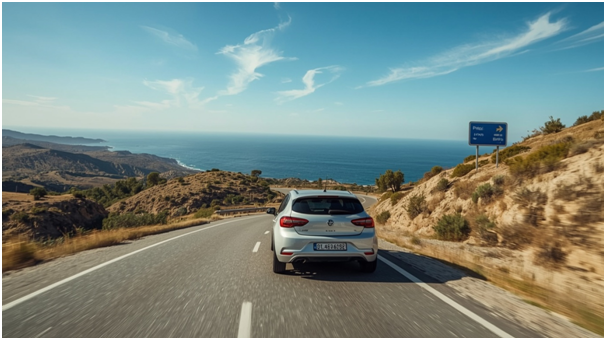
The Island Won’t Wait – and the Bus Schedule Will
Cyprus is compact.
You can drive coast to coast in under four hours.
That sounds convenient – until you realize the most stunning beaches, crumbling monasteries, and vine-covered mountain villages aren’t anywhere near a bus stop.
Public transport exists, technically.
But “technically” is doing a lot of heavy lifting there.
Renting a car in Cyprus is, for most travelers, the difference between a good trip and a genuinely memorable one.
The roads are well-maintained, signs appear in both Greek and English, and traffic outside the main cities is refreshingly light.
But there are a handful of things – rules, quirks, genuinely important gotchas – that catch first-timers off guard every single season.
This guide covers them all.
Before Booking: Age, License, and the Fine Print
Here’s the first thing to sort out before anything else: can you actually rent a car?
Most agencies in Cyprus require drivers to be at least 21 years old with a minimum of three years of driving experience.
Some companies won’t rent to anyone under 25 without a surcharge – the young driver fee is real and occasionally eye-watering.
Drivers over 70 may also face additional charges depending on the company. Worth checking ahead of time.
As for the license itself:
- EU/EEA license holders can drive freely with their national document.
- UK license holders – valid without an International Driving Permit (IDP), though some older paper licenses may need supplementing.
- Non-EU countries with bilateral agreements (including Australia, USA, Canada, New Zealand, Ukraine, Japan, South Africa) – national license accepted for tourist stays of up to six months.
- Everyone else: An IDP is required and must be obtained before arrival.
Always carry your passport alongside your license. Rental papers stay in the car at all times.
And if you’re booking online, use a credit card rather than a debit card, as most companies require a credit card for the deposit hold.
Driving on the Left: the Adjustment No One Talks About Enough
Cyprus drives on the left.
A legacy of British colonial rule, and for many visitors – particularly those coming from continental Europe or North America – it’s the single most disorienting part of the first day.
The steering wheel is on the right side of the car.
Overtaking happens on the right.
At roundabouts, traffic flows clockwise.
Give way to the right.
Dr. Maria Andreou, a road safety researcher based in Nicosia, has noted that the majority of rental car incidents in Cyprus occur within the first 24 hours – almost always at junctions, when drivers instinctively drift to the wrong side.
Her advice: take ten minutes in a quiet residential street before hitting any main road.
A few practical things that help:
- Remind yourself at every junction – especially after stopping. The brain defaults to habit.
- Passengers can help – if traveling with someone, a quiet “stay left” reminder at turns is not annoying, it’s useful.
- Rental cars have red license plates, making them instantly identifiable to local police. They know who’s likely to make mistakes – and they watch accordingly.
Insurance: the Part That’s Easy to Get Wrong
When travelers opt for car hire in Cyprus, understanding the insurance structure in advance saves both money and confusion at the rental desk.
Standard rentals in Cyprus include third-party liability and fire coverage as mandatory minimums.
What they don’t always include – depending on what’s been booked – is Collision Damage Waiver (CDW) and theft protection.
These are often offered as add-ons at the counter, sometimes at significantly marked-up rates.
The smarter approach: purchase excess insurance through an independent insurer before arrival.
It’s almost always cheaper, and it covers the deductible in case of damage – that gap between what the insurance covers and what the rental company can charge to your card.
A few things worth knowing:
- Super CDW reduces the deductible further – sometimes to zero – but costs more daily.
- Personal Accident Insurance (PAI) is separate and optional.
If a fine lands on the car during the rental, the company receives it and passes it on.
Unpaid fines increase by 50% after 15 days, and unresolved ones can complicate re-entry into EU countries.
Northern Cyprus: the Border Rule that Surprises Everyone
This one catches travelers off guard more than almost anything else.
Rental cars from the Republic of Cyprus cannot cross into Northern Cyprus.
Full stop.
The insurance becomes invalid the moment a rental vehicle crosses the UN Buffer Zone.
Most companies explicitly prohibit it in the rental agreement, and some will charge the full vehicle value if the car is taken north.
It’s possible to cross personally, on foot, as a pedestrian, and hire a separate vehicle on the northern side.
Third-party insurance is sold at some checkpoints, but it does not cover the rental car itself in case of accident or breakdown.
Roadside assistance cannot cross the border to help either.
For travelers with itineraries that include both the Republic and the north: plan for two separate arrangements, not one.
On the Road: Speed, Fuel, and the Local Style
Speed limits follow a clear structure:
- Urban areas: 50 km/h
- Secondary roads: 80 km/h
- Highways: 65–100 km/h
Speed cameras are common, and fines are enforced.
There are no highway toll fees – a small but welcome detail.
Blood alcohol limit is 0.05% – lower than in the UK and much of Europe.
In practical terms: roughly half a pint of beer.
The local wines and spirits are genuinely excellent, so the honest advice is simple: designate a driver, or park the car for the evening.
Fuel stations are plentiful in urban areas.
In rural or mountain regions – the Troodos range, the Akamas Peninsula – gaps between stations get longer.
Fill up before heading into unfamiliar terrain.
Most stations have automated payment systems and operate around the clock.
One last thing about local driving style: Cypriot drivers are assertive.
Not aggressive, exactly – but confident in ways that can feel sudden to visitors used to more deferential traffic.
Nobody is going to wave you into a merge.
Take your space calmly, indicate clearly, and don’t expect elaborate courtesies.
The roads are fine.
The style just takes half a day to calibrate to.
The Roads Less Driven – and Whether a Standard Car Handles Them
The main highways and tourist corridors are in excellent condition.
Off those routes – particularly heading into the Troodos Mountains or along the Akamas coastline – roads narrow, surfaces roughen, and gradients steepen.
For travelers planning to stick to coastal cities and popular destinations, a standard compact works perfectly.
For anyone eyeing the mountain villages, forest trails, or remote beaches of the Paphos region, an SUV hire is worth considering.
Not mandatory – but noticeably more comfortable.
One thing to confirm before booking: off-road driving typically voids the rental agreement.
Even a detour onto an unpaved track can constitute a violation under the contract terms.
If in doubt, check the specific wording with the rental company before heading somewhere ambitious.
Final Thoughts on Getting It Right
Cyprus rewards travelers who come prepared.
The roads are genuinely good, the distances manageable, and the freedom of moving on your own schedule – particularly outside the main tourist calendar – is something no organized tour can replicate.
The things that trip people up are almost always administrative: the wrong insurance level, the surprise at left-hand driving, the border restriction discovered too late.
None of it is complicated once it’s known in advance.
Book early – especially for summer, when prices climb steeply, and availability tightens.
Confirm the insurance terms before signing.
Take a few quiet minutes on the first day to settle into the left-side rhythm.
After that, the island opens up in the best possible way.
The mountains and the sea are both waiting, and neither requires a tour bus schedule to reach.
Additional Resources
 How to Plan a Safe & Smooth Self-drive Trip in Iceland without Rental Car Surprises
 A Perfect Location for Business: Cyprus Rules and Other Aspects to Consider
 How a Sports Car Transforms the Road and Opens Up New Routes
 4×4 Camper Rentals and F-Road Safety in Iceland
 4 Tips for Safe Car Rental in Maui
 The Smart Traveler’s Guide to Managing Expenses on the Road












I got caught out the first day trying to turn right at a roundabout before remembering we drive on the left here, definitely take a slow drive around a quiet street first.