The Last Place Most Travelers Ever Consider – And the One They Never Stop Talking About
Antarctica doesn’t show up on most people’s travel lists.
It’s not the kind of destination that pops up in a flight deal newsletter or gets casually mentioned over dinner.
And yet – here’s the thing – travelers who actually make it to the Antarctic Peninsula tend to come back different.
Not rested, not tanned.
Different.
Is it safe?
Yes – genuinely, surprisingly safe – provided the trip is planned properly and booked through a reputable operator.
The Antarctic Peninsula sits among the most tightly regulated travel destinations anywhere on Earth.
Visitor numbers are capped by treaty.
Environmental protocols are enforced with teeth.
The operators who run expeditions here follow safety standards that would make mainstream cruise directors nervous.
But preparation still does all the heavy lifting.
Here’s what actually matters before heading south.
What’s Waiting Down There – And It’s a Lot
The Antarctic Peninsula is the continent’s northernmost stretch – the arm that reaches toward South America, as if trying to escape.
It’s the most accessible part of Antarctica, and accessible is a relative term that still involves crossing some of the roughest water on the planet (more on that shortly).
What travelers find there defies easy description.
Glaciers the size of city blocks calve into water so blue it looks digitally enhanced.
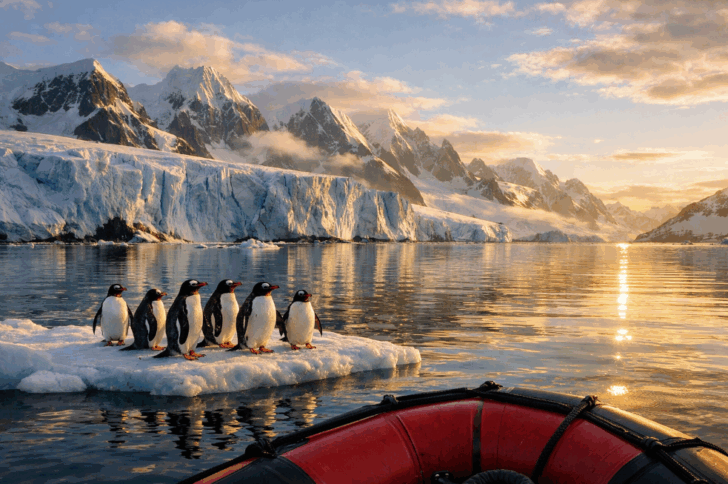
Gentoo, chinstrap, and Adélie penguins nest in colonies so chaotic and loud they’d give any major airport a run for its money.
Humpback whales surface alongside Zodiac boats – close enough to smell, which is an experience in itself.
Leopard seals drape themselves over ice floes with the energy of someone who has absolutely nowhere to be.
The Gerlache Strait and the Lemaire Channel – nicknamed the “Kodak Gap” well before smartphones existed – rank among the most photographed stretches of water on Earth.
For good reason.
Travelers booking an Antarctic Peninsula cruise with a small-ship expedition operator get something genuinely different from mainstream cruising.
Vessels carrying under 150 passengers can navigate channels that larger ships can’t physically enter – and everyone goes ashore at once, no queuing in rotation groups while the scenery changes.
Timing: There’s One Window, And It’s Worth Knowing Well
Antarctica runs on one season.
The continent opens to visitors from late November through early March – the austral summer – when daylight stretches past 20 hours, and temperatures hover somewhere around freezing.
Occasionally warmer.
Sunny, calm days have been documented where people shed their outer layers entirely.
Packing for that possibility while also packing for wind and sleet is just the Antarctic way.
The season breaks down roughly like this:
- November–December – snow-covered landscapes, penguin courtship, egg-laying, smaller crowds, dramatic cold-light photography
- January – peak season; chicks hatch, whale activity surges, warmest temperatures on record
- February–March – fledging chicks, golden late-summer light, calmer seas on average, that bittersweet end-of-season feeling
None of these windows is wrong.
Wildlife photographers tend to chase late January into February.
Those after the frozen, cinematic version of the continent lean toward November.
The honest answer is: it depends on what the traveler is actually there for.
The Drake Passage – Might as Well Address It Directly
Every Antarctic travel guide eventually gets here.
The Drake Passage – the open-ocean stretch between the southern tip of South America and the Antarctic Peninsula – has a reputation that dates back centuries.
Waves of six to ten meters aren’t unusual.
Some crossings are smooth.
Many aren’t.
The term “Drake Lake” versus “Drake Shake” is expedition-speak for the difference, and experienced travelers have learned not to bet on which one they’ll get.
That said, modern expedition vessels are engineered specifically for this environment.
Stabilizing fins reduce roll considerably.
Captains with polar experience read ice and weather patterns with a fluency that takes years to develop.
The ships don’t blunder through; they adapt continuously.
Dr. Richard Wiese, explorer and long-time polar travel advocate, has pointed out that under-preparation and choosing inexperienced operators – not the environment itself – account for most serious incidents in Antarctic travel.
The baseline check for any operator: IAATO membership (International Association of Antarctica Tour Operators).
Non-members shouldn’t be considered.
Beyond that, travelers should verify:
- Emergency evacuation insurance coverage – the Antarctic minimum is $200,000 USD
- Staff-to-passenger ratio of at least 1:9 for shore landings
- All expedition staff hold certified polar guiding credentials – not just general crew assignments
- The vessel carries an ice rating and a full Zodiac landing fleet
- Packing – including the things people consistently forget
Antarctica’s weather shifts without much warning.
Bright sun at 9 am, horizontal sleet by noon, glassy calm by 3 pm.
Layers aren’t a suggestion – they’re the entire logic of Antarctic dressing.
Most expedition operators provide waterproof boots for shore landings and a branded parka.
Personal kit should include merino wool base layers, windproof fleece mid-layers, waterproof gloves in two pairs (one will get wet, count on it), UV400 sunglasses, and a thermal hat that actually covers the ears.
Antarctic ice reflects roughly 80% of UV radiation – sunburn on grey overcast days catches people off guard every single season.
The most consistently forgotten item?
Seasickness medication.
Bring it regardless of confidence in sea legs.
Prescription patches, antihistamine tablets, and ginger capsules – ideally all three, in case one doesn’t work.
The Drake doesn’t care about pride.
The Rules – And Why They Genuinely Matter
Antarctica is governed by the Antarctic Treaty System, a multilateral framework that covers environmental protection, scientific conduct, and tourism behavior.
Travelers aren’t just passing through a remote spot; they’re entering one of the last places on Earth where the ecosystem hasn’t been broken yet.
IAATO guidelines – enforced by all compliant operators – prohibit approaching wildlife closer than five meters, removing anything from the continent, and operating drones in coastal zones.
Biosecurity protocols require full disinfection of boots and clothing between landings to prevent non-native species transfer.
Here’s the payoff: a penguin walking directly up to a visitor’s boot – something that happens regularly – does so because it has no learned reason to fear humans.
That took generations of careful, rules-based tourism to build. It’s genuinely worth protecting.
Closing Thoughts – For the Traveler, Actually Considering This
The Antarctic Peninsula isn’t for travelers who need reliable Wi-Fi and predictable weather.
It’s for people who want to stand in front of a glacier and recalibrate their sense of scale – who are willing to trade a rough two-day ocean crossing for something that won’t wear off.
Travelers who prepare properly – right operator, right gear, right expectations about the Drake – consistently report the same thing on the return crossing: every grey, lurching, seasick hour was worth it.
That’s not the kind of thing people say about a beach holiday.
It’s the kind of thing said about experiences that actually change something.
Antarctica has a way of doing exactly that.
Additional Resources
 Gay Travel in Australia: A Guide of Handy Tips, Festivals and More
 Travel Safety Tips For College Students
 Money Safety Tips When You Travel To Baguio City, Philippines
 25 Travel Safety Tips
 10 Low-Tech Travel Safety Tips That Still Work in 2025
 How to Choose the Best Destination for Your Educational Travel: Tips and Tricks