


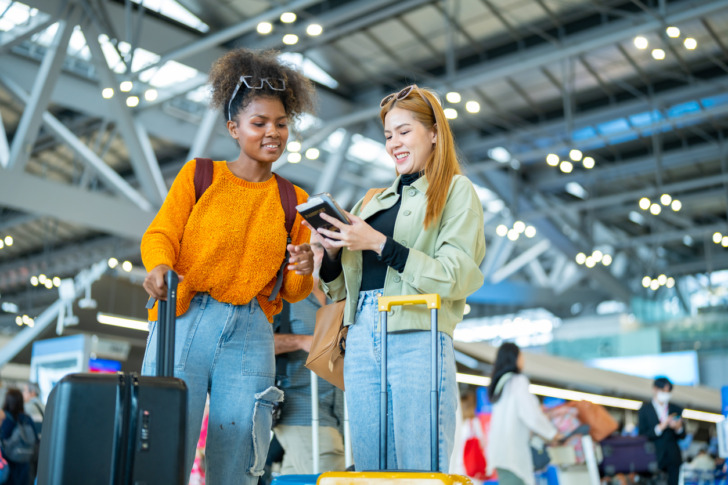
Sit in any international airport for an hour.
Watch the people moving through it.
Something has shifted — and it’s not just the phones.
The way people carry themselves through unfamiliar places has changed in a way that’s hard to put your finger on at first, but becomes obvious once you notice it.
Less stopping.
Less fumbling.
Fewer people standing at metro exits looking lost.
Travelers today move with a kind of quiet confidence through places they’ve never been before — and the reasons behind that shift go deeper than any single app or gadget.
Planning Less, Adapting More
A decade ago, the well-prepared traveler arrived with a printed itinerary, a highlighted guidebook, and hotel confirmation numbers written on paper.
Today, that same traveler books a flight, screenshots a few recommendations, and figures out the rest on arrival.
This isn’t recklessness — it’s a structural change in how travel information works.
According to a 2023 Booking.com Sustainable Travel Report, 50% of global travelers say they prefer to leave room for spontaneity rather than plan every detail.
Meanwhile, Google’s Travel Insights data consistently shows that the window between travel search and booking has compressed dramatically, with a growing share of trips booked within 48 hours of departure.
The flexibility that used to require local knowledge or a knowledgeable guide now lives in your pocket.
Travelers have simply adjusted their behavior to match what’s available to them — and that includes being better prepared for staying safe in unfamiliar places.
This is perhaps the most visible change.
The classic tourist tell — standing still on a corner, phone raised, trying to orient a map — is disappearing from city streets.
Today’s traveler tends to move continuously.
They’ve already absorbed the route.
They’re listening for an audio cue.
Or increasingly, they’re glancing at a heads-up prompt through a pair of AI glasses that feeds turn-by-turn directions or real-time translation without requiring them to stop, look down, or pull anything out of their bag.
It’s a small behavioral shift with real implications.
Keeping your eyes up and your hands free in an unfamiliar city isn’t just more comfortable — it changes how aware you are of your surroundings, how approachable you look to locals, and how quickly you can adapt when something unexpected happens.
Here’s a brief look at how navigation habits have evolved across traveler types:
| Traveler Type | 10 Years Ago | Today |
|---|---|---|
| Solo backpacker | Paper map + hostel tips | Offline maps + audio navigation |
| City tourist | Guidebook + printed directions | Real-time wearable or audio prompts |
| Business traveler | Hotel concierge | App-based, hands-free routing |
| Adventure traveler | GPS device | Lightweight wearables + satellite messaging |
The common thread across all of them: fewer stops, less fumbling, more attention on the environment rather than the screen.
Packing Lighter, Carrying Less
The one-bag movement has gone mainstream.
What used to be the territory of minimalist travel bloggers is now visible on any budget airline, where overhead bins fill with 20-litre backpacks rather than rolling suitcases.
A 2024 Skyscanner travel trends report found that carry-on-only travel has increased significantly year over year, with younger travelers in particular citing the ability to move freely through cities as a top reason for packing light.
The shift is partly cultural, but it’s also driven by consolidation.
Tools that once required separate devices have merged:
- A dedicated camera → smartphone or wearable
- A translation phrasebook → real-time AI
- A travel alarm clock → phone
- A portable speaker, guidebook, paper tickets → all gone
The same logic applies to physical gear.
Travelers are increasingly choosing multi-purpose, durable items over single-use products.
The traveler who used to check a bag for a five-day trip often doesn’t anymore — not because they’re braver about laundry, but because they’re carrying fewer things that actually need packing.
More Present Than Before — Paradoxically
Here’s the counterintuitive part.
As travelers have become more connected and more tech-equipped, many report feeling more present in the places they visit — not less.
The era of photographing every meal and every cobblestone street is quietly giving way to something more selective.
Part of that is aesthetic fatigue — Instagram has made heavily curated travel content feel exhausting rather than aspirational.
But part of it is also a growing set of tools that capture or assist passively, without demanding full attention.
Sunglasses with a camera are a good example of how this plays out practically.
Rather than stopping to take a photo, raising a phone, framing a shot, the moment is captured — or not — without it becoming an event.
The traveler stays in the scene instead of stepping out of it to document it.
It’s a subtle thing, but it adds up over the course of a trip. Less time performing the experience, more time having it.
Trusting Strangers — But Differently
The relationship between traveler and local knowledge has also shifted.
Guidebook authority has collapsed.
In its place: a web of peer reviews, community forums, and real-time local tips from people who were somewhere last week, not last year.
According to the UNWTO World Tourism Barometer, peer-driven travel research has become one of the dominant forces shaping destination choice — outpacing traditional travel media in most age demographics under 45.
This has made travelers more trusting in some ways — more willing to follow a recommendation from a stranger on a travel forum than from a branded hotel concierge.
But it’s also made them more discerning.
A recommendation with 400 recent data points carries more weight than a guidebook entry from three editions ago.
The practical result is that travelers arrive with a better-calibrated picture of what’s actually there right now.
That said, more digital reliance also means more exposure — something worth keeping in mind when it comes to traveling overseas.
What’s Actually Driving It
Pull all of this together and the shape of the change becomes clearer.
Today’s traveler moves differently not because they’re a different kind of person, but because the friction points that used to slow everyone down — orientation, language, documentation, gear weight — have been reduced or removed.
The response to less friction is more flow.
Less stopping.
More presence.
More willingness to go somewhere unfamiliar and trust that you’ll figure it out.
Travel has always evolved with the tools available to it.
Trains changed where people went.
Budget airlines changed who could go.
Smartphones changed how people navigated once they arrived.
The current wave — wearable tech, ambient AI, lightweight gear — is changing how people actually feel while they’re there.
And that last part might be the most significant shift of all.
Additional Resources
 Why Online Entertainment is Now Essential for Michigan Travelers
 6 Tips for Avid Travelers to Avoid Getting Into Trouble
 New Zealand Digital Safety Guide: Essential Tips for Tech-Savvy Travelers in 2026
 Top Safety Advice for Solo Travelers
 9 Reasons to Move to Hawaii
 What Travelers Gain by Pairing Hotspots With Modern eSIM Tools











I noticed people hardly ever stop to pull out maps or phones anymore, which made the airport feel way less chaotic than usual.
I noticed so many travelers just breezing through the terminal with nothing but a small backpack and their phones, barely stopping to check anything.