


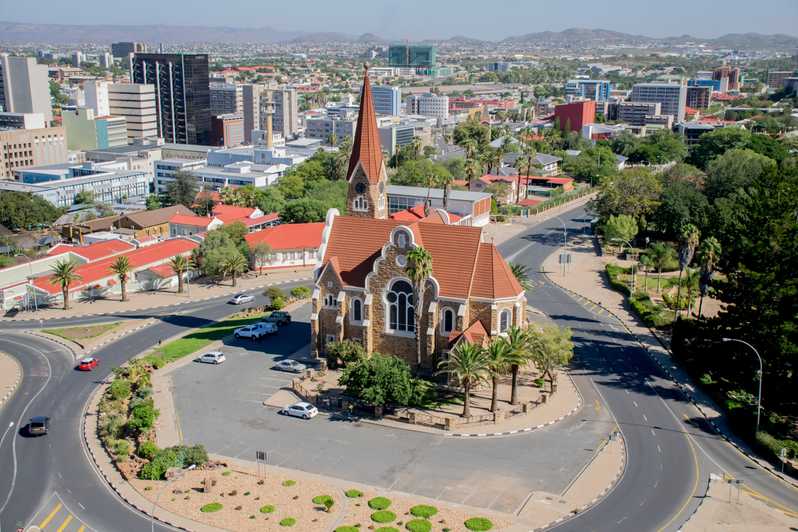
Windhoek sits high in central Namibia, framed by dry hills and broad skies, and it feels very different from the crowded capitals many travelers expect in Africa.
It is the country’s political and cultural heart, but it also works as a practical launch point for road trips to Etosha, the Namib Desert, Swakopmund, and the Skeleton Coast.
I find Windhoek interesting because it mixes German colonial architecture, modern government buildings, township culture, open-air craft markets, and a dry climate that makes the city feel sharp and bright almost year-round.
It is not a city that overwhelms you with blockbuster attractions, but it does reward travelers who pay attention.
In safety terms, Windhoek is not a place to fear, but it is absolutely a place to approach with awareness, especially after dark and in areas where opportunistic crime is common.
Warnings & Dangers in Windhoek

OVERALL RISK: MEDIUM
Windhoek is safer than many large cities in the region, but it is not carefree. Most visits are trouble-free, especially for travelers who use hotel transport, avoid flashing valuables, and stay alert in public. The biggest concern is street crime, not political violence or major instability. Daytime sightseeing is usually manageable, while nighttime wandering raises the risk.

TRANSPORT & TAXIS RISK: MEDIUM
Getting around Windhoek is generally straightforward, but transport risks come from using unvetted taxis, walking long distances, or moving around after dark. I would avoid random street pickups and use transport arranged by hotels or reputable operators whenever possible. Road safety also matters, especially if you plan to rent a car and drive outside the city.

PICKPOCKETS RISK: MEDIUM
Pickpocketing is not the city’s only crime issue, but petty theft does happen in busy public areas, parking lots, shopping zones, and places where distracted travelers stand out. Windhoek is a city where phones, wallets, and bags can disappear quickly if you let your guard down. Keep valuables out of sight and do not leave items visible in cars.

NATURAL DISASTERS RISK: LOW
Windhoek does not face the kind of major natural disaster profile that defines some destinations. There is no major earthquake threat, and tropical storm risk is not a typical issue here. The more realistic environmental concerns are heat, drought, occasional heavy seasonal rains, and flash flooding in certain low-lying spots during the wetter months.

MUGGING RISK: MEDIUM
Muggings and bag snatches are a real concern, especially after sunset or in poorly lit areas. Travelers are more vulnerable when walking alone, carrying visible electronics, or stopping at isolated places. The risk is not so high that you should avoid Windhoek, but it is high enough that careless behavior can quickly turn into a bad experience.

TERRORISM RISK: LOW
For most travelers, terrorism is not a defining safety issue in Windhoek. The city’s main risks are common crime and practical urban security issues. That said, basic global travel awareness still applies in public places, transport hubs, and government areas. For everyday tourists, terrorism is far down the list compared with theft, mugging, and road safety.

SCAMS RISK: MEDIUM
Scams in Windhoek are usually low-tech and based on distraction, overcharging, false helpfulness, or opportunistic targeting of visitors. Taxi pricing confusion, fake assistance at parking areas, and people trying to divert your attention are more likely than elaborate fraud. The best defense is to keep interactions polite, brief, and controlled, especially with strangers approaching suddenly.

WOMEN TRAVELERS RISK: MEDIUM
Women can enjoy Windhoek, including solo travelers, but extra caution is smart. I would not recommend walking alone at night, accepting rides from strangers, or relaxing your guard in quiet areas. Daytime travel with normal city awareness is usually fine, but the safest approach is to use known transport, stay in well-reviewed accommodation, and avoid isolated nightlife movement.

TAP WATER RISK: MEDIUM
Tap water in Windhoek is often treated and used locally, but I would still advise travelers to be selective. Visitors with sensitive stomachs may do better with sealed bottled water, especially at the start of a trip. Be careful with ice, and remember that standards can feel inconsistent depending on exactly where you are eating, staying, or refilling.
Safest Places to Visit in Windhoek
Central Civic Landmarks
The area around Christuskirche, the Independence Memorial Museum, and nearby government buildings is one of the better places for first-time visitors to start.
It is central, recognizable, and generally easier to navigate in daylight than the quieter outskirts.
I like this part of the city because you can absorb Windhoek’s history without immediately feeling lost.
Still, keep your phone tucked away when not using it, even here.
Klein Windhoek and Upscale Hotel Areas
Klein Windhoek is one of the city’s more comfortable zones for visitors, especially if you want restaurants, guesthouses, and a calmer atmosphere.
Many travelers feel more at ease here because accommodation standards are strong and movement is easier when arranged by car.
It is not crime-proof, but it is one of the better bases for people who want a lower-stress stay.
Namibia Craft Centre and Indoor Shopping Spots
For shopping and souvenir browsing, controlled indoor settings are usually safer than wandering through unfamiliar streets with cash in hand.
The Namibia Craft Centre is a smart stop because it offers culture, crafts, and a more structured environment.
Shopping malls and known commercial areas are also easier to manage than isolated open spaces, especially if you keep your bags zipped and your attention up.
Nature Stops Close to the City
Places like the National Botanic Garden and Avis Dam can be rewarding, but they are safest when visited in daylight and ideally not completely alone.
I would treat these as good half-day outings rather than spontaneous solo adventures late in the day.
Go with a plan, carry minimal valuables, and return before dusk.
Places to Avoid in Windhoek
Isolated Streets After Dark
The biggest mistake in Windhoek is assuming that a quiet nighttime walk is harmless.
Many incidents happen when travelers are on foot in poorly lit or low-traffic areas.
Even neighborhoods that feel fine by day can become riskier at night.
I would strongly avoid walking between bars, restaurants, hotels, or ATMs after dark unless you are using arranged transport.
Katutura Without Local Guidance
Katutura is culturally important and often included in organized township tours, but it is not a neighborhood where I would suggest casual independent wandering.
Visiting with a knowledgeable guide is one thing.
Turning up alone because you are curious is another.
The area is large and varied, and not designed for tourist convenience or security.
Respect it, and do not improvise there.
Deserted Parking Areas and Roadside Stops
Parking lots, roadside pull-offs, and places where vehicles stop at lights or intersections can create opportunities for theft.
Smash-and-grab style incidents and opportunistic targeting near vehicles are well-known concerns.
Never leave bags, laptops, cameras, or passports visible in a parked car.
If someone tries to distract you while you are stopped, stay focused on your belongings and surroundings.
Informal or Unfamiliar Outer Areas
Tourists rarely need to spend time in remote residential fringes or unfamiliar outer districts unless there is a clear reason.
The danger is not that every such area is automatically unsafe.
The problem is that visitors often cannot read the environment well.
Stick to known routes, known venues, and transport arranged through people you trust.
Safety Tips for Traveling to Windhoek
- Do not walk around at night unless necessary. This is the single most important rule. Windhoek changes after dark, and risks rise fast when visitors are on foot. Even short distances that look manageable on a map are better done by an arranged taxi or hotel shuttle.
- Use the transport recommended by your hotel or host. A trusted ride reduces risk immediately. Ask your accommodation which taxi company or transfer service they recommend, and keep that number handy. It is a simple habit that can save you from overcharging, confusion, or unsafe situations.
- Keep valuables out of sight at all times. Do not advertise your phone, camera, jewelry, or cash. Windhoek rewards low-profile travelers. A crossbody bag, front-pocket wallet, and a habit of putting your phone away after checking directions go a long way.
- Never leave anything visible inside your car. This includes charging cables, shopping bags, jackets, and backpacks. Visible objects can signal that something valuable may be inside. If you rent a car, treat the trunk like a necessity, not an option.
- Be extra careful at ATMs and in parking areas. Use ATMs inside malls, banks, or major hotels where possible. Avoid withdrawing cash at night. Count money discreetly, and do not let strangers “help” you with a machine, a parking space, or directions when you are handling valuables.
- Choose accommodation in a well-known part of the city. Paying a little more for a stronger location is worth it in Windhoek. Areas popular with business travelers and tourists usually offer better security, better transport access, and less guesswork when returning in the evening.
- Take organized township or cultural tours instead of exploring independently. If you want to see more local life, do it with structure. A reputable guide adds safety, context, and respect to the experience. It also helps you avoid unintentionally entering areas or situations you are not equipped to judge.
- Stay alert when driving, especially beyond the city. Road safety matters in Namibia. If you are self-driving, plan routes carefully, avoid fatigue, and be cautious at dawn, dusk, and night when visibility drops and road hazards increase. Inside Windhoek, stay aware at intersections and when parking.
- Be selective with food and water if your stomach is sensitive. Many travelers are fine, but it is smart to ease into local conditions. Use sealed water at first, be cautious with ice, and choose busy, reputable places to eat. A stomach issue on a road trip across Namibia is not something you want.
- Trust your instincts and leave awkward situations early. If a place feels wrong, too quiet, too aggressive, or too chaotic, do not stay to be polite. Travel safety often comes down to making small decisions quickly. Windhoek is much easier to enjoy when you act early instead of hesitating.
So... How Safe Is Windhoek Really?
Windhoek is not wildly dangerous, but it is also not a city where I would tell travelers to relax completely.
The truth sits in the middle.
Most tourists who use common sense, move carefully, and avoid unnecessary nighttime exposure will likely have a smooth visit.
The main threat is crime of opportunity, especially theft, muggings, and incidents involving valuables left in cars or carried too openly.
What makes Windhoek different from destinations with a higher overall threat level is that the risk is usually manageable rather than constant.
You are not likely to arrive and feel immediate chaos.
In fact, many parts of the city feel calm, orderly, and easy to navigate during the day.
That calm can be misleading if it makes you lower your guard.
I would describe Windhoek as a destination best suited to travelers who are comfortable with basic urban awareness.
Couples, independent travelers, and even solo women can visit successfully, but they should build safety into their routine rather than treat it as an afterthought.
If you stay in a solid neighborhood, use arranged transport, avoid walking at night, and protect your belongings, Windhoek can be a rewarding and very doable stop.
How Does Windhoek Compare?
| City | Safety Index |
|---|---|
 Windhoek Windhoek |
65 |
| Swakopmund |
72 |
 Stowe Stowe | 78 |
| Mount Prospect | 86 |
 Agra Agra | 50 |
 Almaty Almaty | 29 |
 Belem Belem | 59 |
| Winfield | 88 |
Useful Information

Visas
Visa rules depend on your nationality, so check before booking. Namibia now offers visa-on-arrival and online application options for many travelers, often for stays of up to 90 days. You will usually need a valid passport, proof of onward travel, and accommodation details. Entry policies can change, so confirm requirements before departure.

Currency
Windhoek uses the Namibian dollar, and the South African rand is also commonly accepted. Cards work in many hotels, restaurants, and larger shops, but carrying some cash is still wise for taxis, tips, and smaller purchases. Exchange money at banks, airports, or reputable bureaus, and avoid changing cash informally.

Weather
Windhoek has a dry climate with warm to hot days for much of the year and cooler nights, especially in winter. The rainy period generally falls in the warmer months, while winter is drier and crisp after sunset. Pack light clothing, sun protection, and one warmer layer because evenings can feel surprisingly cool.

Airports
Most international travelers arrive through Hosea Kutako International Airport, which sits outside the city, while Eros Airport handles many domestic and regional connections. The safest way into Windhoek is a prearranged transfer, hotel pickup, or a reputable taxi. I would not land without knowing exactly how I am getting into town.

Travel Insurance
Travel insurance is a must for Windhoek and for Namibia in general. It should cover medical care, theft, trip delays, and emergency transport, especially if you plan to drive or continue into remote areas. Even a smooth city break can get expensive fast if you lose luggage, need treatment, or face a transport problem.
Windhoek Weather Averages (Temperatures)
Average High/Low Temperature
| Temperature / Month | Jan | Feb | Mar | Apr | May | Jun | Jul | Aug | Sep | Oct | Nov | Dec |
|---|---|---|---|---|---|---|---|---|---|---|---|---|
| High °C |
30 | 29 | 27 | 26 | 23 | 20 | 21 | 23 | 27 | 29 | 30 | 31 |
| Low °C |
17 | 17 | 15 | 13 | 9 | 7 | 6 | 9 | 12 | 15 | 15 | 17 |
| High °F |
86 | 84 | 81 | 79 | 73 | 68 | 70 | 73 | 81 | 84 | 86 | 88 |
| Low °F |
63 | 63 | 59 | 55 | 48 | 45 | 43 | 48 | 54 | 59 | 59 | 63 |
Namibia - Safety by City
| City | Safety Index |
|---|---|
| Swakopmund | 72 |
| Windhoek | 65 |














Affordable
Having a friend from Windhoek from Uni was the main reason I visited the place. Without a familiar face, I don’t think I would have found myself visiting Namibia. Its a pretty affordable city and I think their national museum is housed in the oldest building in the city too, as there is history related to Namibia’s independence there as well. Try out the food as well in the market.
Windhuk is not as bad as described!
It’s a bit exaggerated about Crime in Windhoek. In comparison to other Cities in Europe & USA or South Africa, Windhuk is still a safe City. I’m long term traveller, Swiss with a Namibian registered car. Never had an issue while driving! Since COVID Poverty has increased, thanks to a corrupt Government who doesn’t care for its people. Pickpocketing can happen like every where in the World. But it’s not high risk during the day. Begging is more of a problem.
Good!
Thank You
I never expected Windhoek to have such an interesting mix of history and nature. It’s pretty cool that you can explore the old Parliament building and then head out to help with big cat conservation in the same day. That kind of vibe really adds to the experience.
Curious about your experience at the Cats Unlimited expedition; did you feel a strong connection with the animals there?
If you find yourself in Windhoek, don’t skip the Cats Unlimited expedition; there’s something surreal about being up close with big cats while knowing you’re helping their conservation.
Have you ever joined the Cats Unlimited expedition around Windhoek, and if so, what was it like being part of the conservation efforts there?
Spent a week in Windhoek and the dry, sharp light at the open-air craft market made everything look vivid, but I still felt on edge walking back after dark so I stuck to busier streets.
Wait, are you serious that the dry air makes everything feel so sharp and bright and the open-air craft markets felt oddly intense to me, did you get that same buzz?
Walking through those dry streets with the sun beating down, you really notice the mix of old and new that gives Windhoek a vibe unlike anywhere else; just be ready to keep your wits about you when it gets dark.